
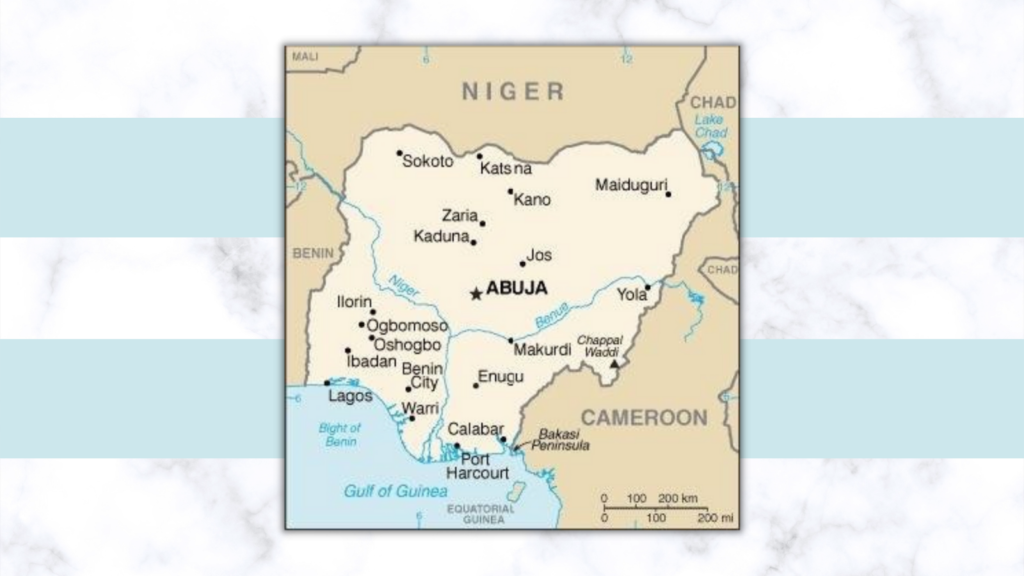
Take a country with the largest population on the African continent; add political strife, ethnic violence and roads that are difficult to travel and are often nonexistent; and the task facing International Mission Board (IMB) missionaries can seem insurmountable.
Nigeria has a diverse population, said Lucy Driggers, IMB engagement team and research coordinator for West Africa. “There are at least 450 people groups in Nigeria, meaning that they each have their distinct cultures, and most have their distinct languages,” she said. That is more people groups than any other country in West Africa.
Although Southern Baptist missionaries have worked in Nigeria for 156 years — the longest field of continuous service for Baptist missions work — as of August 2006, IMB data showed there is no outside group implementing church-planting strategies among 200 of the people groups.
And about 55 people groups are classified as unreached, Driggers said. The IMB defines an unreached people group as one in which fewer than 2 percent of the population is evangelical Christians.
Although English is the official language of Nigeria, large portions of the unreached population speak only tribal dialects, making the spread of the gospel more difficult. About 300 of the nation’s people groups have no access to the Bible in their own language, according to the IMB Web site.
Clint Bowman and his wife, Harriet, are IMB engagement team missionaries for West Africa. Their responsibilities include researching the various people groups in Nigeria, developing a plan for reaching the unreached groups and training both IMB workers and Nigerian nationals to work with unreached groups.
Clint Bowman pointed out the need for volunteers to map out remote villages, saying that the true number of unreached people groups is not certain.
“We have not researched all of them,” he said. “To research the people groups, we have to go into the bush and make contact with the people. We desperately need volunteers to help us.”
Judy McEachern, administrative assistant in the IMB’s West Africa Regional Office, pointed out that through a Web site, the IMB is actively seeking volunteers to go to Nigeria. “It is a God-sized task, and it is not glamorous but there are so many needs.”
The Bowmans train the volunteers to map out villages, often with a Global Positioning System, and then report back. Once people groups are identified and the level of evangelization is determined, the Bowmans develop a plan for reaching each group. The plan may be carried out either by the IMB or in conjunction with the Nigerian Baptist Convention.
“The plan includes trying to get [American] churches to adopt the people groups. This is a very high priority for us,” Bowman said.
When American churches contact the Bowmans about adopting a people group, they receive a list of eligible groups to choose from. “They can take their time and pray over this,” he said.
The people groups vary in size from 1,000 members to as many as 150,000, and the relationship is not one to take lightly, according to Bowman. The missionaries ask churches to make a commitment of 3–10 years. There are different levels of commitment, from praying for the group to doing whatever is necessary to introduce the gospel to the group.
This year, Nigeria is the focus of the International Mission Study leading up to the Lottie Moon Christmas Offering. “The number [of volunteers] is up from last year,” McEachern said. “I feel like this emphasis is going to make a difference. With God’s people praying, eyes are being opened to the needs in West Africa.”
For more information on adopting a people group or volunteering, visit www.gowestafrica.org. Click on “Go!” and then on “Volunteers,” and scroll to the bottom for Nigeria’s requests.

Share with others: