
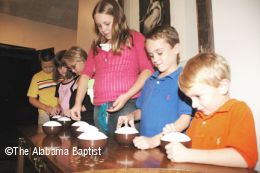
As World Hunger Day approaches, Alabama Baptist churches are once again readying their checks, their change and their rice bowl banks. But in increasing numbers, they are putting a new spin on totaling up their pennies — they’re counting sheep instead.
Or they’re counting cows, goats or chickens, according to Joanne Farmer, whose office of Christian ethics and chaplaincy ministries at the Alabama Baptist State Board of Missions (SBOM) distributes the rice bowls and collects Alabama Baptists’ world-hunger offering each year.
This offering is emphasized on World Hunger Day, observed this year Oct. 8.
“We’ve seen more interest in donating towards livestock for the hungry, and we had a church recently call and ask us to price a chicken for them,” she said.
After a little research, Farmer had a cost-per-chicken figure for the church, which used the figure to break down its world-hunger offering total by the number of chickens that could be purchased.
It’s a concept some churches believe provides a visible goal for the help they give, Farmer said.
The rice bowl offerings that go through the state office to the International Mission Board’s (IMB) World Hunger Fund are not earmarked specifically for these animals, but a lot of the money is used for projects that purchase farm animals for food and income sources. Other funding for livestock purchases comes directly to the IMB from individuals and churches that give to specific projects.
One current World Hunger Fund project aims to purchase 600 sheep for Turkish villagers living below the poverty line in Macedonia, where the IMB hopes to plant churches after meeting the people’s physical needs.
One sheep for the project costs $122.
“[S]ome of the project totals are quite large. However, without the generosity of Southern Baptists who contribute in seemingly small ways, we would not be able to combine all of the gifts to undertake the projects at all,” said Megan Stull Riel with the IMB’s World Hunger & Relief Ministries. “God has greatly provided the inroads to many around the world through the World Hunger Fund.”
In 2005, First Baptist Church, Vernon, in Lamar Baptist Association gave toward a World Hunger Fund project that provided 200 goats and two months’ worth of feed to improve the farms of 15 to 20 families in Central and Eastern Europe.
“During Vacation Bible School (VBS), the kids gave $428.50 that year for the goats and bought twice as many as we thought we would,” said Sue Allen, church secretary. “The kids even named the goats they bought.”
During this year’s VBS, the children at First, Vernon, continued the effort, giving money toward a chicken project in Mexico.
Other state Baptist churches are also taking on livestock projects directly through the IMB and other organizations such as Samaritan’s Purse, Baptist World Aid (BWAid) and Heifer International (www.heifer.org), according to the organizations’ giving records. All offer specific livestock projects that need support and list individual animals for purchase. Gift animals range from rabbits to llamas and honeybees to heifers and range in price from several dollars to several thousand dollars.
The Baptist Church of McAdory, Bessemer, in Bessemer Baptist Association is one such church that decided to donate toward a specific cause through Samaritan’s Purse, purchasing 40 goats for a small mountain village in Honduras. The goats are priced at $70 each on the Samaritan’s Purse Web site, www.samaritanspurse.org.
Pastor Bill McCall said that despite being in the middle of a major building project, church members caught the vision and quadrupled their original goal of 10 goats.
“We love to find tangible ways to participate in missions. It’s definitely something we would consider being involved in in the future — the response was overwhelming,” he said.
Tom Layton, communications officer with Samaritan’s Purse, said livestock project is continually drawing more interest from churches and individuals, with nearly 6,000 people giving goats and dairy animals in 2004.
“Livestock projects have been really popular. People like to feel like they are giving something tangible and know the specific way their gift is going to make a difference,” he said.
A BWAid heifer project in Cambodia also grew this year, with 15 new heifers purchased so far in addition to the 16 given last year — eight of which produced offspring.
The project serves as a long-lasting companion ministry to the organization’s food distribution in the country and is a thumbnail of BWAid’s work worldwide, which is highlighted during BWAid Hunger Month, observed in October (www.bwanet.org/bwaid).
Joe Bob Mizzell, director of the SBOM office of Christian ethics and chaplaincy ministries, said he hopes Alabama Baptists will continue to raise their awareness level of the needs and ways to give.
More than 12,800 rice bowls and 15,000 envelopes were sent out to Alabama Baptist churches from Mizzell’s office in 2005, with a total collection of $705,602.71.
Some 8,000 bowls and 10,000 envelopes have already gone out this year.
“We’re hoping to raise the bar this year with our state-giving totals,” Mizzell said.
For more information about rice bowls and the state offering for world hunger, call Farmer at 1-800-264-1225, Ext. 233. For information about IMB World Hunger & Relief Ministries, call Riel at 1-800-999-3113, Ext. 1736.


Share with others: