
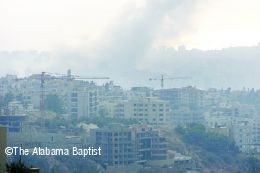
As bombs continue to drop and the death toll rises in the Middle East, Baptists and other evangelicals are scrambling to provide aid for refugees and decide what stance to take on the violence that is casting those refugees out of their homes.
At press time, 51 Israelis — including 33 soldiers — had died and 1,233 Israelis — mostly civilians — had been wounded since Hezbollah guerillas from Lebanon crossed into Israel July 12, killing three Israeli soldiers and capturing two, according to Israeli ambulance-service officials.
Lebanese security forces said 398 Lebanese had been killed in the subsequent Israeli air strikes and 1,661 had been wounded. An unspecified number of people also are trapped under rubble, they said.
On July 28, President George W. Bush and British Prime Minister Tony Blair declared that a multinational force should be dispatched quickly to help Lebanon regain control of the southern part of its country from the Hezbollah militia, according to The Associated Press.
The two leaders, however, stopped short of supporting an immediate cease-fire in the fighting between Hezbollah and Israel, which some evangelical leaders have been urging.
A July 21 letter to President Bush, signed by more than a dozen Roman Catholic and Protestant groups, told him his leadership “and the full weight of the United States, acting in concert with the international community, must be applied now to achieve an immediate cease-fire and to launch an intensive diplomatic initiative for the cessation of hostilities.”
Leaders of the European Baptist Federation (EBF) released a statement July 26 in which the 51-nation group “[j]oins the call of the United Nations Secretary General, the European Union and others for an immediate cessation of hostilities, praying for a just and lasting peace for all peoples and a negotiated cease-fire.”
But others — such as the more than 3,500 evangelical Christians who met in Washington July 18–19 to support Israel — hold a differing viewpoint. “We are commanded by Isaiah to speak out for Israel,” said John Hagee, pastor of the 18,000-member Cornerstone Church in San Antonio. “We want Israel to have the ability to respond in the fullest measure.”
It’s this perspective that Martin Accad, academic dean of the Arab Baptist Theological Seminary (ABTS) in Beirut, Lebanon, criticizes in a July 20 article posted on Christianity Today’s Web site.
Accad questioned the notion that Israel is the perpetual victim. He criticized American evangelical and political leaders who hold views that dictate unconditional support for Israel. “But how is it that … so many … believe that apocalyptic destruction of all but their beloved Israel will be ‘a precursor to global salvation’? ‘Nuclear-armed Iran’?
How about the Israeli jet planes that are bombing, as I write, my … sisters, my brothers … ?”
After Israeli jets began bombing Accad’s country — and sent Beirut’s airport up in flames — he found himself stranded in the United States, where he had come to teach a two-week course at Fuller Theological Seminary in Pasadena, Calif.
Accad’s been forced to watch from afar as his family, friends and colleagues attempt to minister to the masses — some of whom are staying in his seminary and its sister school, Beirut Baptist School (BBS).
Hundreds of refugees have fled to the schools for shelter, and Baptists there are providing them with food and medical care.
“A Muslim cleric who has been involved regularly in some of the activities of our Institute of Middle East Studies was overwhelmed that both ABTS and BBS are lending a hand to displaced [Shiite] families,” said Nabil Costa, executive director of the Lebanese Society for Educational and Social Development, which owns the seminary and the school.
“You are different,” the cleric said to the seminary’s provost, according to Costa.
Bruce Mewbourne, a Chalkville native and minister of global outreach and evangelism for Eagle’s Landing First Baptist Church, McDonough, Ga., and others got to minister to the refugees at the schools when the attacks halted their return to the United States from a missions trip to Beirut.
“We moved to the seminary campus and stayed there, helping assemble packs for the refugees,” he said. “We also helped with the twice-a-day prayer times and praise times.”
Mewbourne, his teammates, local Baptists and refugees worshiped in a building shaken by heavy shelling three miles away.
“That’s never been a part of my worship experience before,” he said. “But we were happy to encourage [local Baptists] and happy to help.”
After 18 days trapped in beleaguered Lebanon, Mewbourne’s happy to be back at home in the United States.
In addition to the group of Southern Baptist volunteers with whom Mewbourne traveled, one short-term volunteer with American Baptist Churches International Ministries has returned to the United States.
But other Baptist workers are still in the area, including two other American Baptist missionaries who stayed behind at ABTS to minister to refugees and deliver aid to those who need it.
The International Mission Board (IMB) reported that all its workers in the area are safe but for security reasons, declined to specify their whereabouts.
At press time, the IMB had sent $50,000 in aid to Lebanon and had other aid projects going in Israel as well.
Southern Baptist workers also reported distributing aid provided by the IMB’s hunger relief fund.
“We were astounded by [Arab Baptists’] resilience. Several of the members of the Baptist church are volunteering to distribute food to hungry people. We thought that was pretty amazing since they are also victims,” said a Southern Baptist worker from Alabama who works in the Middle East. “Many looked tired but they all praised God for His sustaining power.”
Baptist World Aid, the EBF and BMS World Mission (affiliated with the Baptist Union of Great Britain) have sent a grant of $15,000 to Lebanon to fund food, medications and other supplies, and Baptists in Canada and Virginia and the Cooperative Baptist Fellowship have pledged support.
(Compiled from wire services)
Share with others: