
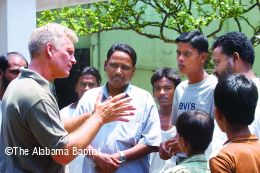
As the youngest high school football coach in South Carolina Class 4-A history, 24-year-old Carter Bolin relished the challenge of motivating his team before games against bigger, better opponents.
“I’d point across the field and tell my players, ‘Look at those guys. Every one of them has 20 pounds on every one of you. It’s gonna be fun to smack ’em,’” Bolin said. “Eventually my guys would start yelling, ‘Yeah! Yeah! Lemme at ’em!’ They might bounce off the bigger guys a few times, but they’d eventually wear ’em down.”
Bolin took his undersized, overachieving team to the state semifinals for the first time since 1950 — thrilling the whole town.
“I could’ve run for mayor after that,” he claimed with a grin.
Instead he joined the ministry staff of his church, East Cooper Baptist, next door to the Charleston-area high school where he coached. He spent the next 18 years helping mobilize the growing congregation — especially its young people — to follow Christ into the world. Local outreach spurred international involvement. About 30 East Cooper members have become missionaries after participating in short-term church missions trips.
On the flight home from a two-week missions trip to India, it was Bolin’s turn to be mobilized — by his wife, Vienna.
“It was miserable, it was hot, it was all the things India can be,” he recalled. “But the people just broke our hearts.
There was a spiritual void, and they were filling it with idols.
“When we got on the plane, Vienna looked at me and said, ‘I could never serve in India.’ By the time we touched down in the States, she was in tears. She said, ‘I realized that I trust God with my kids in a safe place like our home, but I don’t trust Him enough to take them to India. We’re just paying lip service.’
“So we ended up mobilizing ourselves and our kids to India. We just felt, ‘If not us, who? If not now, when?’ It was time for me to put up or shut up, because this is what I’d been preaching.”
That was five years ago. Today, as a Southern Baptist missionary strategy coordinator, Bolin faces a bigger challenge than he ever encountered as a coach.
The challenge lies in the Indian state of West Bengal, where William Carey launched the modern missionary movement more than two centuries ago. Today it is home to at least 80 million people. The majority are Hindus — the primary focus of Christian missions among Bengalis since Carey’s day. But one in four Bengalis proclaims Islam. Muslims comprise a quarter of the 16 million people of Calcutta (Kolkata), West Bengal’s sprawling capital.
As in much of the rest of India, however, the real numbers can be found in the villages. In West Bengal and neighboring areas of India, Bengali-speaking Muslims predominate in about 30,000 villages.
Bolin’s vision and goal as a strategy coordinator is to see Jesus Christ glorified through a church-planting movement among the 27 million Muslims of West Bengal and nearby areas. How? By planting a jaamat — or house church — in every one of those villages.
It’s doable and it’s already starting. More than 100 jaamats — with about 1,000 former Muslims who have become baptized followers of Isa Masih (Jesus Christ) — have sprouted across West Bengal during the past two years.
That represents only a typical month’s spiritual harvest across the border in Bangladesh (once part of Bengal), where several powerful church-planting movements among Muslims now count more than half a million believers.
But momentum is gathering.
“We feel like we’re on the end of the runway getting ready for takeoff,” Bolin reported. “Things are starting to happen.”
What’s it going to take to reach the other 29,900 Muslim communities? Bolin’s team intends to see at least 50 reproducing churches begun in each of West Bengal’s 15 majority-Muslim districts, along with three to five churches in each of Calcutta’s Muslim areas. These churches, in turn, will multiply to finish the task.
“We want to build this into the DNA, into the very fabric and backbone of every jaamat: Now that you’ve heard the good news and received it, you must share it with neighboring villages,” Bolin explained. “It’s the principle of reproduction, of multiplication, rather than addition.”
EDITOR’S NOTE — Names changed for security reasons. (IMB)


Share with others: