
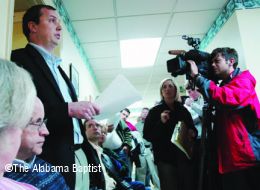
Argo Mayor Paul Jennings knows how to stun a crowd, and he proved it April 6.
More than 75 people stuffed into the Argo Town Hall sat patiently — while also anxious and tense — for more than two hours while town council members moved methodically down a seemingly never-ending agenda.
Most people were present for one issue — electronic bingo gambling — and that item was last on the list.
Jennings had announced a few days earlier that he was ready to propose the much-talked-about ordinance that would legalize electronic bingo gambling in Argo.
He said the first reading of the ordinance would be April 6, and the second reading and vote would be April 7.
Argo residents turned out ready to argue for and against the issue and to watch as it was dealt with once and for all. But when the council finally made it to the coveted agenda item, Jennings knocked the wind out of the crowd. He said the council was “still at a 3-to-3 deadlock” and because of that he had decided it would be best not to propose the ordinance that night.
Instead, “I’m going to ask ACAT (Argo Community Action Team — a group of volunteers that assists with various community needs and provides poll workers during elections) if they would be willing to help us out with a problem … that we hold a nonbinding election.”
And so was the decision — a mock referendum to be held April 21 from 7 a.m. to 7 p.m. in Argo.
“Let’s do what everyone up here is wanting to do — let the people vote,” Jennings said. “I feel like the best situation is to let the people tells us what they want.”
But council member Steve Medori is not buying the mayor’s move.
“This election proposal is a desperate tactic to get accomplished what he can’t get through the proper elected officials,” Medori said, noting he had no idea Jennings was going to call off the council vote.
“Elections are influenced a great degree by money at the last minute,” he said. “The gambling interest can afford to call people in this community 10 times (between now and the election).”
And while Jennings encouraged council members to vote however the majority of the people vote, Medori would not commit to that if the people vote in favor of gambling.
“This is a family-oriented community. And gambling is inconsistent with that. … It preys upon the least fortunate among us. It takes their rent, their grocery money, their car payment,” he said. “I don’t want to be a part of anything that will prey upon the least among us.”
But Jennings sees electronic bingo gambling as the only way Argo can get out of its financial woes.
“Bingo is the only viable option that has been presented to the council with the ability to aid funding our fire and police departments and pay down our debts prior to cutting services,” he said. “As it stands now, approximately May 6 will be the last day our fire department will exist without additional funding.
“Several … have recommended bankruptcy,” Jennings noted. “I feel it is wrong to bankrupt when you have a viable, legal way to survive.”
Earlier this year, Jennings introduced Mississippi businessman John McLeod, head of Roadhouse Gaming Systems LLC, to Argo. And since then McLeod has been checking out land options for his proposed 15-acre gambling complex in Argo.
McLeod’s attorney and Hugh Holladay, attorney for Argo, have been working out the details of the soon-to-be proposed ordinance, said Andrea Jennings, Argo town clerk. She said while the mayor is using Ashville’s ordinance as an outline, “it is very different from Ashville’s.”
An ordinance to legalize electronic bingo gambling in Ashville was passed in December, but the city remains tied up in court over the issue.
The Alabama Baptist tried to obtain a copy of the Argo ordinance, but the mayor refused to make it public.
“It will not be open for public review until it has been voted upon,” the town clerk explained.
The mayor did explain the difference between his proposal and the Ashville ordinance.
“We only allow one establishment every five miles,” Paul Jennings said. “We collect revenue for Argo quarterly and in advance. We only allow what is permissible by law.”
McLeod said in a Feb. 19 letter to the citizens of Argo that it is Attorney General Troy King’s 2004 findings that “ruled video bingo is an acceptable form of bingo.”
But King’s findings are not an official opinion, nor ruling.
“The 2004 findings are not an opinion. … And they are specific to the counties we looked at,” King said in an earlier interview with The Alabama Baptist.
To read King’s findings, visit www.thealabamabaptist.org and click on the Anti-Gambling Resource Center button at the bottom left of the home page.
In McLeod’s letter, he explained that he met Paul Jennings in January after electronic bingo gambling became an option for Argo.
“In our discussions regarding the possibility of bringing charitable bingo to Argo, I was assured that only one operation would be allowed in Argo,” McLeod wrote, outlining the commitment he would make “for this reason alone.”
McLeod said he would pay an annual business fee of $850,000 to Argo and that he would pay an annual machine permit fee of $100 per machine to the town. An additional $50,000 would be paid to local charities each month, he added.
“Ninety-five percent of the anticipated revenue will be derived from surrounding communities, not Argo itself,” he explained. “Furthermore, a number of local jobs will be created. This is a win-win situation for your community.
“Personally, I am not aware of any other legitimate business that offers the possibility of erasing your town’s entire debt in less than two years,” he said.
But Argo resident Phillip Nelson disagreed.
“I know we are having tough times, but that is when tough decisions have to be made,” he said. “If you allow McLeod to come in, he will have the influence. Normal Argo citizens won’t have a voice like [we] did before.”
Nelson said he had researched Walker County’s crime statistics and found that “prostitution has increased and petty theft has gone up quite a bit” since electronic bingo gambling halls have sprung up.
Another concern is the potential for creating gambling addicts in the community, he added.
And then there is the “Sweet Home Alabama” legislation being debated in the Legislature.
“If it passes, bingo won’t be allowed in St. Clair County,” Nelson said. “Then where are we going to be?
“The money sounds good, but you’ve got to look at where it comes from,” he said. “This is something the people don’t want. They don’t want to live around it.
“Argo is better that that,” Nelson said. “I think we could come together as a town and solve this.”
Fellow Argo citizen James Thomas agreed.
“We need genuine growth. … Future business is the future of this town,” he said, noting he is a small business owner (not in Argo) and would volunteer to help develop some economic proposals. “There are other alternatives that should be considered. … There are good ways to get sustainable tax revenue in this city if the councils wants to work for it.”
Thomas also noted his concern about making this decision before the legality of electronic bingo gambling has been determined.
“Right now it seems the (town) council is basing their entire future on something that is about to hit the Supreme Court and what happens then if it is ruled illegal?” he asked. “Why not wait four or five months and see what the Supreme Court says?”
Argo citizen Betty Bradley said electronic bingo gambling is “the only option” for the town.
“We have tried donations and road blocks but have not been able to raise enough money to save them (fire and police departments),” she told the town council. “I do not think bingo will turn this little town into the hell hole that some would want us to believe.”
Stacey Allen, of Argo, said she is worried about “the hell hole.”
“I do not want my child growing up in this,” she said. “Morally and religiously, I think it is wrong.”
Plus, “you can’t have just one,” she added. “We aren’t just going to have one.”
Nelson agreed that was a concern of his as well.
“Ashville promised the same thing, that there would be only one, but (now) the city clerk says they knew there would be more than one,” he said. “They will find a way to get in.”
Prior to the bingo gambling discussion, ACAT presented the fire department with a check for $3,506.80, which came from a recent road-block fund-raiser.
This, along with the $55,221.99 given by families of the town, brings the town’s Fire Drive total to $58,728.79, reported Andrea Jennings.
The Fire Drive is an effort to help solve the fire department’s financial problems. Each family in Argo has been encouraged to donate at least $100 to the department.
Paul Jennings also read a letter from Metro Bank in Ashville, Argo’s bank, where Don Perry, president and chief executive officer of the bank, acknowledged the town’s financial concerns.
The bank board of directors donated $800 to Argo. Argo also received a $500 donation for the fire department from Alabama Power.
It was also reported at the April 6 meeting that Argo had been approved for a loan from the Alabama League of Municipalities with permanent financing up to 28 years. This loan would be available for the construction of a new municipal complex.
Still “Argo has been used to $28,000 per month in sales tax,” Jennings said. “That has dropped to $18,000 recently and is now $14,900.66.”
But Joe Godfrey, executive director of Alabama Citizens Action Program, said gambling is not the answer.
“Gambling takes money from the losers and gives no products or services back in return,” he said. “The only people that benefit are the casino owners and whatever tips they like to give to the local government, but all of that money is coming out of the pockets of those who live in that community or surrounding areas.”
For more information on electronic bingo gambling in Alabama, visit www.thealabamabaptist.org.



Share with others: