
When the earthquake struck, Lim Yew was walking across campus at the boarding school where he taught kindergarten. The ground buckled and the powerful tremor knocked him off his feet. He watched in horror as the buildings around him began to crumble.
At least 150 kindergartners were in Lim’s building.
When the tremor subsided, Lim scrambled to his feet and ran to the rubble of the kindergarten building. He could hear trapped children and teachers calling for help.
A few other survivors joined Lim as he feverishly began digging through the broken pieces of the building. They began to find children who were still alive, terrified and badly injured. They also came across lifeless bodies.
Hours later, they had pulled 50 children from the ruins of the kindergarten building. At least 100 more were buried beyond reach.
Lim finally gave up searching the building debris and turned his attention to finding his own family. He located his wife’s partially exposed body in the rubble of their apartment building. He never was able to find their child.
The 7.9-magnitude earthquake that struck China’s Sichuan province May 12, 2008, destroyed lives as well as buildings. The disaster killed as many as 87,000 people and caused an estimated $146.5 billion in damage. Nearly 5 million people were left homeless as entire cities were leveled and villages disappeared under landslides.
“There are several cities, including Lim’s, that will never be rebuilt. The ground is too unstable,” said Pam Wolf, who with her husband, Ben, directs work in the Asia Rim for Baptist Global Response (BGR). “Millions of people can never go home. Everyone lost family and friends in the earthquake. The pain and grief on that scale is almost impossible to comprehend.”
The raw emotion still felt by Sichuan’s survivors presents a key opportunity for Southern Baptists to minister to hurting souls, Ben Wolf said. And after intensive and careful planning, a program has been launched to train teachers to help children deal with the emotional trauma they are suffering. The initiative, which has been sanctioned by the Chinese government, is the first of its kind in the country.
“In China, many children go to boarding school as early as 3 years old, so … it was decided the best and fastest way to help the children was to train their schoolteachers to help them,” Pam Wolf said. This also meant helping teachers process their own grief and pain.
“Ben and I were privileged to join in the first official training of schoolteachers from the quake area. … Sixty teachers were involved,” she said.
The weeklong program organized the teachers into small groups and engaged them in activities designed to help them express pent-up emotions about the losses they had suffered because of the earthquake.
During one activity, Lim shared about not being able to rescue the kindergartners and of losing his wife and child.
As he spoke, other members of his group listened intently, tears streaming down their faces. They all nodded in silent understanding. It was the first time Lim had talked with anyone about his experience.
“Guilt has festered and is so painful in these schoolteacher’s hearts,” Ben Wolf said. “During these sessions, they were able to share these things with one another and be understood.”
During the training, Southern Baptists showed teachers how to use books on trauma and grief, Pam Wolf added.
“These books (provided by Southern Baptist relief funds) can aid the teachers as they walk through the effects of post-traumatic stress syndrome with the children in their classrooms,” she said.
Another resource Southern Baptists helped provide for “was a session given to hug therapy,” Ben Wolf said.
Pam Wolf added, “These hurting schoolteachers experienced the touch of their peers and the release of emotions it brought. They realized how important this would be for their students.”
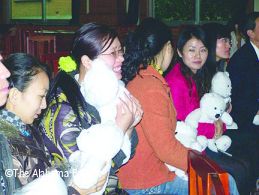
The Southern Baptist contribution to that session was a fuzzy teddy bear with the Chinese characters for “peace” and “joy” stitched on the bottoms of its feet, which teachers can use as a tool to help guide children toward emotional healing.
“Chinese children don’t normally have toys, and these teachers had never experienced the comfort and joy of hugging a soft teddy bear,” Pam Wolf said. “There were a lot of tears and then many smiles. … Wherever our bears go, they bring smiles and laughter and lots of hugs.”
When the program is launched in the schools, each child who is counseled will receive a teddy bear, Ben Wolf said. Teachers will use teddy-bear hand puppets to draw the children into conversations that will help them process their emotions about the earthquake.
BGR has a goal of providing 150,000 sets of “Books & Bears” for earthquake survivors — demonstrating God’s love by helping them experience emotional healing and renewed hope.
EDITOR’S NOTE — Lim Yew’s name was changed for security reasons. (BP)


Share with others: