
Baptists in America — who find themselves members of a religious majority or plurality in many areas — would do well to remember their humble beginnings as a persecuted minority and to reconsider the dangers of a “majoritarian faith,” Baptist scholar Doug Weaver urged during the recent Baptist history conference in Huntsville.
While Baptists proudly point to religious liberty and church-state separation as their distinctive contributions to American history, Weaver said contemporary Baptist heirs to that tradition may find it difficult to relate to their 17th-century forebears, who were part of a persecuted minority of dissenters to official state-supported denominations.
“We are used to being a part of the majority. We are the Bible Belt, maybe even the buckle of that belt. We are Baptists, the largest body of Protestants in the United States,” said Weaver, a religion professor at Baylor University in Waco, Texas. “We have climbed the ladder of success numerically, socially and intellectually. We have an air of respectability. We are the majority; hear us roar.”
In contrast, he noted it was the persecuted minority groups — the Anabaptists, Baptists and Quakers — who “pushed the Christian world in the 16th and 17th centuries to face the music and hear cries for complete religious liberty.”
Weaver said John Leland, the famous 18th-century Baptist advocate of religious freedom, noted that whenever you try to force a union between church and state in order to create a Christian nation, you have created a monster that denies liberty of conscience to anyone who dares to be different.
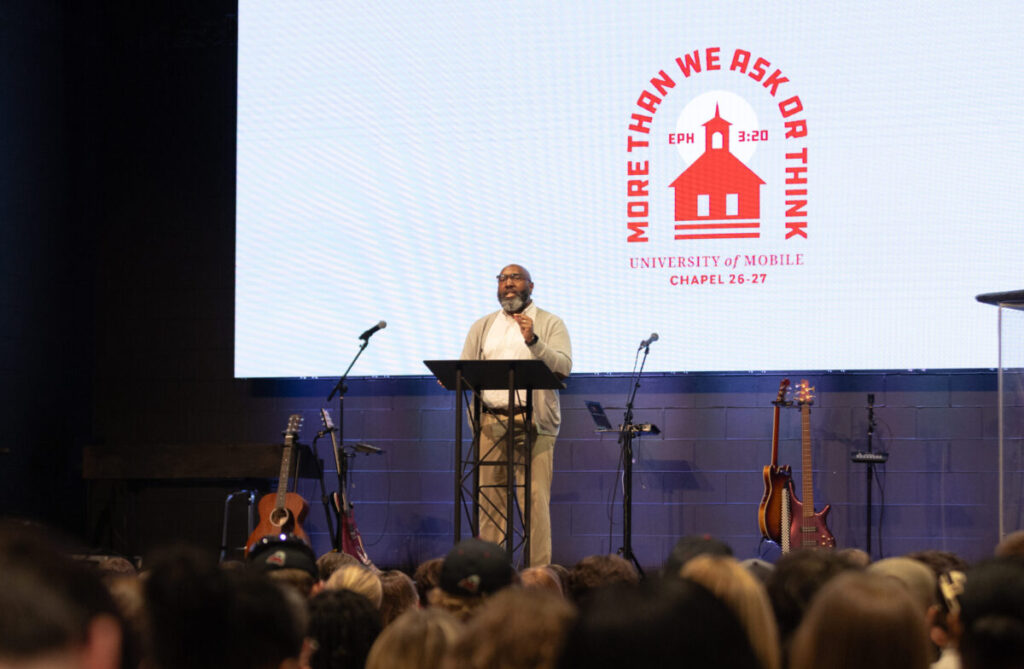
Weaver delivered the sermon at the annual conference of the Baptist History & Heritage Society, held June 4–6 (see story, this page). The message received first-place honors in the group’s annual Baptist heritage preaching contest.
Weaver challenged American Christians to reread their Bibles from the perspective of a religious minority group. From Moses and the Exodus to Daniel in the lion’s den to the teachings of Jesus to accounts of the early church, the Bible is filled with examples of the persecuted minority, he said.
“Can we hear Bible passages in the way that persecuted minorities have heard them when they talk about freedom? Can we read Bible passages like persecuted minorities would when they were being denied religious freedom by the government or by a majority group that was defining how free they can be?” he asked.
“I wonder who really understands the implications of freedom,” he added. “Those people who don’t have it and desperately want it, or those people who are threatened that they might lose control of it?”
The Bible and church history call 21st-century Baptists to “look in the mirror of our ‘majoritarian faith’ and see its risks,” Weaver said. Among those risks are that:
– “We cease to affirm religious liberty for all because we are now the majority.”
– “We fear losing our status as a majority faith in an ever-increasing[ly] pluralistic world, so our response is to assert oppressive control only majorities can pull off.”
– “We now become [like] the colonial Puritans and think that freedom is only for us and should be defined by us.”
– “We hide behind the rhetoric of being a Christian nation to justify religious favoritism toward our majority viewpoint,” forgetting that “Baptists’ forefathers and foremothers were persecuted by so-called national churches.”
– “We abandon — even denigrate — the separation of church and state that we desperately cried for when we were a minority faith in our infant years.”
– “We forget that freedom is a gift from God and not ours to withhold.” (ABP)



Share with others: