
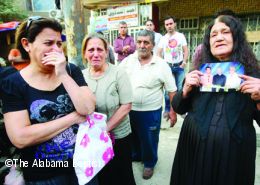
Iraqi Christians residing in Baghdad are living in fear following an Oct. 31 al-Qaida-related attack on a Catholic church that left 58 dead and 75 wounded.
And now with the release of a Nov. 3 message from the Islamic State of Iraq, the group with ties to al-Qaida responsible for the attack, saying Christians in the Middle East are “legitimate targets” for violence, Christians have more reason to fear.
Part of the message, which was circulated via e-mail by the U.S. Commission on International Religious Freedom, read, “The Ministry of War of Islamic State of Iraq declares that all the centers, organizations and bodies of Christian leaders and followers have become legitimate targets by the Mujahedeens, wherever our hands will reach them.”
The recent message is even more troubling as it follows the attack on Catholic Christians in Baghdad.
On Oct. 31, approximately 10 Islamic militants stormed Our Lady of Salvation Chaldean Catholic Church during evening Mass after detonating bombs in the neighborhood, gunning down two policemen at a nearby stock exchange and blowing up their own car.
It was reported that more than 100 worshipers had gathered that evening and were held as hostages in exchange for the release of jailed al-Qaida militants and Muslim women. The militants sprayed the sanctuary with bullets and ordered a priest to call the Vatican to demand the release of Muslim women whom they claimed were held hostage by the Coptic Church in Egypt, according to The Associated Press. They also reportedly demanded the release of al-Qaida prisoners.
In the end, at least 58 people were killed, the majority of them worshipers, including several priests, and 75 were wounded.
Mike Edens, professor of theology and Islamic studies at New Orleans Baptist Theological Seminary who ministered in the Muslim world for 25 years, said to understand the accusation against the Coptic Church, one must understand that historically claims have been made against Christian churches in the Middle East that they are comforting and protecting women who are identified as Muslims.
“Frequently these women have come from a Christian background, and they were secured as a wife by a Muslim and were forced to convert or chose to convert, and then they’re seeking to convert back,” Edens said.
“They don’t have the freedom to do that, and they seek the protection of the church, and they may even take vows to be a nun and be in a convent or monastery,” he added. “There is an element of factual basis to the claim, but it’s more complex than the secular news media is capable of helping us understand.”
The claim that al-Qaida in Iraq is making is a red herring because the jihadists make it seem as if they would accept a Christian presence among them if the women were not being held by the Coptic Church, Edens said.
“That is not true,” he said. “Unlike the general Islamic population, members of jihadist Islamic groups, members of al-Qaida in particular in this case, have committed to an ideology that is opposed to all Christians in their midst. Not only that, they are opposed to all other religious expressions including expressions of Islam that are different from their own.”
Al-Qaida has killed more Muslims than Christians and it is antagonistic and belligerent against anyone who holds a different worldview than the jihadist ideal, which is the establishment of a global Islamic republic that is ruled by nothing but the Quran, Edens said.
“It was clearly an attack against vulnerable Christians to try to encourage them to emigrate out of Iraq, to reduce their voice in Iraq, to intimade them,” he said.
And it seems that the Oct. 31 attack is doing just that.
Tony Peck, the Baptist World Alliance (BWA) regional secretary for Europe and general secretary for the European Baptist Federation, reported that the pastor of the Baptist church in Baghdad informed him that the “Christian community is now very fearful for its safety” and that “some of the Baptist believersare talking about moving away from Baghdad to north Iraq, others to Jordan and Syria.”
Peck said he fears that “this very understandable response would leave the Christian church in Iraq even weaker than before.”
It has been estimated that since the invasion of Iraq by the United States and its allies in 2003, approximately half the Christian population has fled the Middle Eastern country, leaving an estimated 550,000 believers. Many of those who remain are increasingly harassed and often experience violence.
In the wake of the attack, Baptists in Baghdad are considering changing the day of worship from Sunday to Friday, the traditional day of worship for Muslims and a practice already adopted by Christians in several Muslim-majority countries, according to BWA.
The jihadists are trying to eliminate voices of peace, moderation and cooperation, and the Christian church is “a large voice in that choir” of making a better society, Edens said.
“We as Christians who are in freedom need to pray for our brothers and sisters not just in Islamic countries but in much of the rest of the world who are suffering for their identification with the gospel of Jesus Christ,” he said. “We have freedom to pray for them and to intercede for them and to learn of their plight and to send missionaries to walk alongside of them, and we need to be faithful in that.”
Raimundo Barreto, the director of freedom and justice for BWA, said, “We deeply regret the unjustifiable murder of Roman Catholic Christians during worship [Oct. 31] in Baghdad.
“We affirm our profound solidarity with the Christian community in Iraq of the prayerful support from the larger Christian family around the world,” he added. “As followers of Jesus Christ, we advocate for true and lasting peace in that region. We call on Christians all over the world to diligently work to prevent any escalation of violence by not repaying evil with evil but by overcoming evil with good.” (Compiled from wire services)



Share with others: