
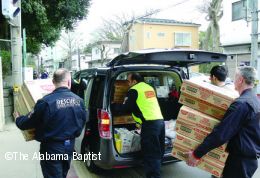
John Hayes, an Alabama Baptist disaster relief coordinator from Birmingham Baptist Association, left for Japan on March 21 as part of a second Baptist Global Response (BGR) disaster relief assessment team to head to the country.
Jeff Palmer, executive director of BGR, announced March 18 that a “second wave” team of two members was set to follow the two-member assessment team that arrived March 12.
Mel Johnson, disaster relief coordinator for the Alabama Baptist State Board of Missions, said Hayes will assist in establishing an incident command center.
“They will set up and work to establish the communication and logistical needs, housing, etc.,” he said.
Once the center is in place, volunteers can be deployed in the areas needing help, Johnson said.
“John will be working outside the disaster zone,” he said. “Our folks are quite some distance away from the nuclear crisis and are under no immediate threat.”
Hayes, a 13-year disaster relief veteran, is a member of Adamsville Baptist Church and is the state convention’s district 11 disaster relief coordinator.
“We just hope to find some areas of missions work that Alabama Baptists can perform to help the people of Japan to get over this disaster and to make their lives better,” Hayes said.
“Hopefully we’ll be able to show the people (of Japan) the love of Christ and make a difference in their spiritual lives.”
Hayes helps train others in disaster relief and has been deployed more than a dozen times to deal with damage from ice storms, tornadoes and hurricanes, Johnson said.
At press time, Hayes was scheduled to be in Japan 10 days. He is joined by a disaster relief specialist from South Carolina.
The center being established by the four-member team will allow “for a unified Southern Baptist disaster relief base,” Palmer said.
Because government restrictions prevent a large-scale overseas volunteer effort, the initial relief projects will be conducted in partnership with Japanese Baptists and other humanitarian groups, he added. The projects will focus on earthquake survivors outside the tsunami zone, where the nuclear crisis is most serious.
“Because so much of the U.S. media coverage is on the nuclear crisis in the tsunami zone, we aren’t seeing how serious the situation is in other areas,” Palmer said. “The area devastated by the earthquake is much larger and the conditions in those areas are very serious.”
Based on the disaster assessment conducted in mid-March, the initial relief effort will focus on life-essential items: basic food items, water, blankets, hygiene supplies and kitchen utensils, said Pat Melancon, BGR’s disaster management specialist. The first round of relief supplies also will include radiation detectors.
Ben Wolf, who with his wife, Pam, directs BGR work in the Asia Rim, said, “We know how anxious our Southern Baptist disaster relief specialists and other volunteers are to come to Japan and help.
“They know people are in desperate need, and they are willing to take whatever risks are necessary to take the love of Jesus to hurting people,” he said. “The reality, however, is that right now we can’t go ourselves, so we will focus on praying and giving so our partners in Japan can get the job done.
“Because of the scale of this disaster, recovery will be a long-term challenge, and we believe there will be plenty of opportunities to go in months to come. For now, donations to Japan relief, especially to the general fund, are the critical need.”
Johnson echoed that request.
“It is important for our churches to understand that the best way we can help support Japan at this time is through prayer,” he said.
“People are looking to collect water and other items for us to ship to Japan, but it is really better to purchase those things in country or from sources close by,” Johnson explained.
But while “in-kind donations need to be withheld at this time, donations made to the disaster relief fund will be sent immediately to teams on the ground, so they can purchase food or whatever is needed,” he added.
The nuclear crisis has led to the evacuation of all International Mission Board personnel in east Japan to southwest of Tokyo. They will be given temporary assignments south of Nagoya. At press time, the relocation was expected to be completed by March 19.
In addition to the Southern Baptist assessment team, Baptist World Aid (BWAid) sent a four-member assessment team, made up of humanitarian relief specialists from Hungary and North Carolina, to Sendai on March 13.
Bela Szilagyi, Rescue24 team leader, said that the city of Sendai, one of the hardest hit areas, “was calm and the spirit of the people was shaken but firm.”
They visited the Katahira evacuation center where approximately 400 people were in the gymnasium and classrooms of a primary school. There was need for food, water and electricity. Rescue24 helped to provide instant noodles, but indicated that “it was almost ‘Mission Impossible’ to procure food for the evacuees. All the stores we saw were closed in Sendai, a city with a population of 1 million.”
The Cooperative Baptist Fellowship also has sent an initial $5,000 for immediate relief to the Japan Baptist Convention (JBC).
And as Baptist volunteers are trying to find ways to help, the JBC is still trying to make contact with some of its churches in the areas hardest hit by the disaster.
Makoto Kato, executive director of JBC, wrote in a letter to BWAid:
“Basically, the inland churches and mission points sustained breakage to their smaller structures, but the larger buildings were not severely damaged. Unfortunately several members of the JBC churches living in the vicinity of the Pacific coastline remain unreachable; we are anxious for their safety.
“Additionally, about half of the 14 JBU (Japan Baptist Union) churches and mission points are along the coast, and most of these have serious damages.”
Pastor Sato of Fukushima Daiichi Baptist Church, which is located close to the troubled nuclear plant, said in a letter to an Alabama Baptist pastor:
“Our church has suffered various damages. I have been unable to contact families living near the coast. The railway station has been washed away by (the) tsunami and our town is really devastated.”
To donate to relief efforts in Japan, visit www.alsbom.org/japan or call 1-800-264-1225. (Compiled from wire sources)

Share with others: