
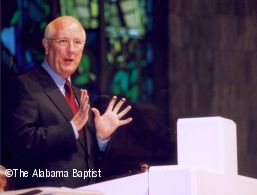
A heartfelt cry for Alabama Baptists to work together in Great Commission Ministries — that is the best way to describe the 189th annual session of the Alabama Baptist State Convention, which met at Dauphin Way Baptist Church, Mobile, Nov. 15–16.
It was an important emphasis for Baptists in Alabama and across the nation because Baptists are struggling with the question of whether to continue the “convention” form of cooperation or embrace the more individualistic “societal” approach of doing missions.
Time and time again during the annual meeting, speakers emphasized the importance of working together. In a theme interpretation, host pastor Adam Dooley pointed out that “multiplication produces faster growth than addition. That is why we partner together as Baptists in Alabama. By coming together, we can impact more people for the cause of Christ.”
Rob Jackson, pastor of Central Baptist Church, Decatur, reminded messengers that in order to “turn the world upside down” for Christ as the church in Philippi did, “Alabama Baptists must work together with radical leadership, the Cooperative Program and missions and evangelism.”
Alabama Baptist State Board of Missions Executive Director Rick Lance pointed to the “yellow shirt army” (credentialed disaster relief volunteers) as evidence of the benefit of working together and praised it for serving 256,147 meals following the April 27 tornadoes, providing 5,253 showers, completing 1,430 chain saw jobs and providing crisis child care for 350 children. Such an impact could not have been made without cooperation, he said.
And there were warnings about the dangers of failing to cooperate. Charles T. Carter, pastor emeritus of Shades Mountain Baptist Church, Vestavia Hills, called it hypocrisy to claim concern for lost people while Cooperative Program (CP) giving continues to decline. He pointed out that prior to the Conservative Resurgence that began in 1979, CP giving averaged 11 percent. Now it is 5.8 percent across the Southern Baptist Convention (SBC). Concern for the lost and failing to give to missions through the primary channel of missions support do not go together, Carter said.
In his president’s address, Mike Shaw, pastor of First Baptist Church, Pelham, warned pastors about the sin of pride. Departing from his prepared remarks, he cautioned pastors about being more concerned about their church getting credit for ministry efforts than the results of those efforts. One approach evidences cooperation. The other, individualistic concerns.
Despite the strong emphasis on “together,” it remains an open question whether Baptists in Alabama and the SBC will continue to embrace the methodology of cooperation as expressed through the convention system.
While support of career and long-term missionaries through the CP continues to decline, there has been a tidal wave of American short-term, local church-based missions trips. In their book, “When Helping Hurts,” Steve Corbett and Brian Fikkert document that in 1989, about 120,000 people participated in short-term missions projects. By 2006, that number had grown to 2.2 million short-term missions participants. That year, Americans spent $1,600,000,000 on short-term missions! That is not a mistake — $1.6 billion.
A growing number of churches are reducing or eliminating their CP giving and redirecting their missions money to church-sponsored events and ministries.
Passion for a particular ministry has led some to focus on one cause (a societal approach) rather than the balanced approach of multiple ministries characteristic of convention organization. Today there is no lack of voices calling for total commitment to international missions or church planting in the major cities of the Northeast or eliminating abortion or serving the poor and hungry or an array of other possibilities.
Yet the recent convention provided an unexpected example of the importance of the balanced approach to missions and ministry. Fred Luter, pastor of Franklin Avenue Baptist Church, New Orleans, and first vice president of the SBC, paused to recognize state missionary James Blakeney during his Tuesday night sermon.
Luter shared that it was Blakeney, then a member of New Orleans Baptist Association’s staff, who sat down with him over lunch on a weekly basis to teach him how to grow a church through Sunday School. “Everything I am today as a pastor, I owe to James Blakeney,” he said. Franklin Avenue is now the largest Southern Baptist church in Louisiana.
Luter is an example of the importance of the training done by associations and state missionaries. Yet that kind of ministry has few champions and many critics. Whether it would exist in the individualistic approach of societal missions is questionable. Convention organization makes it possible because it has proven valuable even if it is not exciting. That is an advantage of the balanced approach.
Individualistic approaches to missions and ministry provide recognition and influence for decision makers. Conventions reflect the corporate will of the body, so leadership and power are harder to come by.
Convention organization is cumbersome. It requires a denominational structure to function. Societal missions takes little organization.
Convention organizations take time to make decisions. Societal missions can turn on a dime. The streamlined, quick-responding characteristics of societal missions appeal to those used to immediate action and quick gratification.
The current debate is not new to Baptists. When Baptists formed the Triennial Convention of 1814 to support Adoniram Judson’s work, the issue of how Baptists would work together was paramount. In his book “The Baptist Heritage,” Baptist historian H. Leon McBeth wrote, “Most of the Northerners preferred to work through an independent society unconnected to the churches, while the Southerners unanimously favored an associational or convention plan based upon the churches.”
For their first decade, Baptists followed the convention model. But in 1826, Francis Wayland, president of Brown University in Providence, R.I., led a successful effort to adopt the societal approach to missions. That plan is still used by American Baptist Churches, formerly known as Northern Baptists.
When the SBC was formed in 1845, a convention plan of cooperation was approved. But by the early 20th century, Southern Baptists argued about being a “Board Baptist,” a derisive term for those who cooperated in missions rather than appoint church missionaries.
Now again the issue of how Baptists will do missions and ministries is at the forefront of Baptist life in Alabama and throughout the SBC. That is the reason convention planners chose the theme “Great Commission Ministries … Together.”
My prayer is that Alabama Baptists and all Southern Baptists will again choose the convention approach to working together that provides a balanced approach of “many … Great Commission Ministries” in Alabama and around the world.

Share with others: