
Shavkat (SHAV kot) sits on the floor in his house in the historic city of Bukhara, Uzbekistan. As he reaches into the communal bowl for another piece of lamb, he glances at the four foreigners who are his guests for dinner tonight.
“Eat more,” Shavkat says insistently in his native Tajik language.
The meal, served on a tablecloth as the family and guests recline on cushions, consists of Tajik salad, various vegetables and a young lamb, purchased and prepared especially for this occasion. Tajiks, known throughout Central Asia for their hospitality, shower visitors with food.
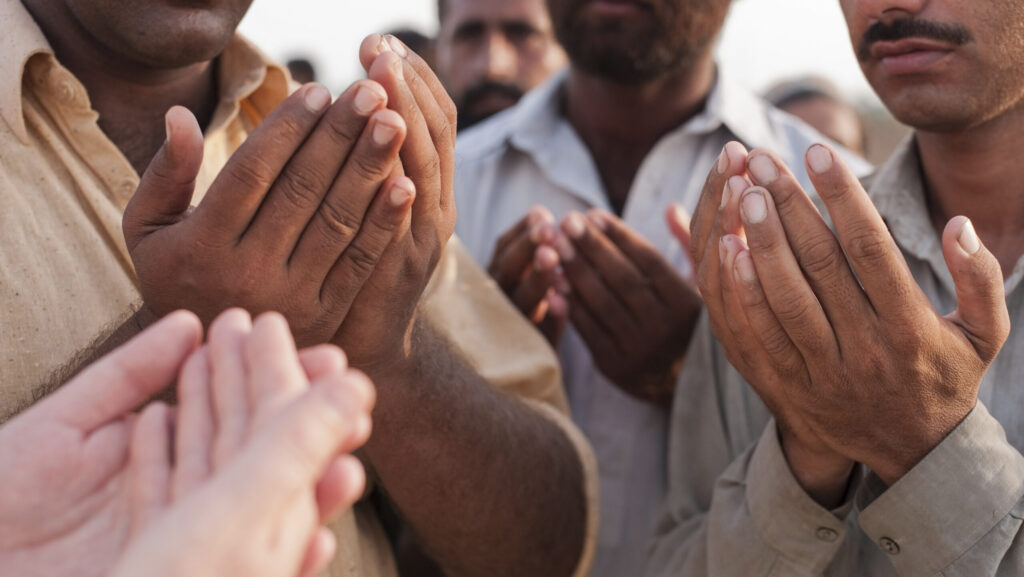
At the end of the meal, Shavkat announces that it’s time for a blessing.
Everyone cups his hands. After the short blessing, Shavkat makes a motion like he is washing his face.
Shavkat is among the 10 million Tajiks living in Uzbekistan, Tajikistan, Pakistan, Afghanistan and China. They are the oldest people group in Central Asia, with roots stretching back to the fourth century, when the Persian Empire extended to the Oxus (now Amu Dar’ya) River. Tajiks are descendants of those Persians and the cousins of modern Iranians.
After the Soviet Union crumbled in the 1990s, Shavkat and many of his Tajik friends began a spiritual quest to find meaning, after years of being told there was no God. Shavkat turned to Islam, the traditional religion of the Tajik people.
Now Shavkat lives as a faithful Muslim. He tries ardently to keep the five pillars of Islam and insists that Muslims and Christians worship the same God. But he doesn’t have a personal relationship with Jesus Christ.
For Shavkat and his fellow Tajiks, the choice of Islam is one of convenience, not of conscience. It’s the easiest way they know of affirming their cultural identity and trying to fill their spiritual longing.
Twenty years ago, religion was one of the most important targets of the Soviet Union’s cultural attack on the region. Soviet leaders infused atheism, the state religion, into the educational system and, therefore, into the country as a whole.
The Russian government also forced the Cyrillic alphabet upon Tajiks in an attempt to assimilate them — and the rest of Central Asia — into Soviet ways.
“It’s better now than before independence,” says “Ravshan,” a professor at an Islamic university in Tajikistan. “We are returning to our traditional culture and wearing our traditional clothes again. The Russian regime brought their culture and imposed it, but now we are free.”
The new spiritual awakening among the Tajiks has done more than just bring people back to Islam. It’s turned some of them to Christ.
Twenty years ago, the number of ethnic Tajik believers could be counted on one hand. Now more than 500 Tajiks know Jesus as their personal Savior.
Most of those new Christians live in Tajikistan, where years of civil war have weakened somewhat the governmental and social pressures on new converts.
Because Islamic culture has a strong tradition of God speaking to people through dreams, many new Tajik Christians say dreams played a vital role in their salvation experience.
“Gulnoza,” a housewife in Dushanbe, Tajikistan, came to Christ through one of those dreams. One night she dreamed that a man with a long beard and long white robe handed her a rose.
Later a Christian neighbor explained to her how God had been reaching out to her with his love. Gulnoza realized it was Jesus in the dream trying to save her. Several weeks later she committed her life to Christ.
“Before I had so many books [about God], and I read them,” Gulnoza says.
“But I didn’t understand about God. But now I feel closer to God. When I opened my heart, Jesus came into it, and I became a child of God,” she said.
But many other Tajiks — like Shavkat — are still searching. (BP)
EDITOR’S NOTE — The names of people have been changed for security reasons.



Share with others: