
For the first time, a group of Baptist moderates is headed toward breaking away from a state convention to form its own convention, a step previously taken by conservatives leaving state conventions in Texas and Virginia.
The first meeting of the proposed new convention, possibly to be called the Baptist Convention of Missouri, is tentatively set for April 18–19 at Fee Fee Baptist Church, St. Louis.
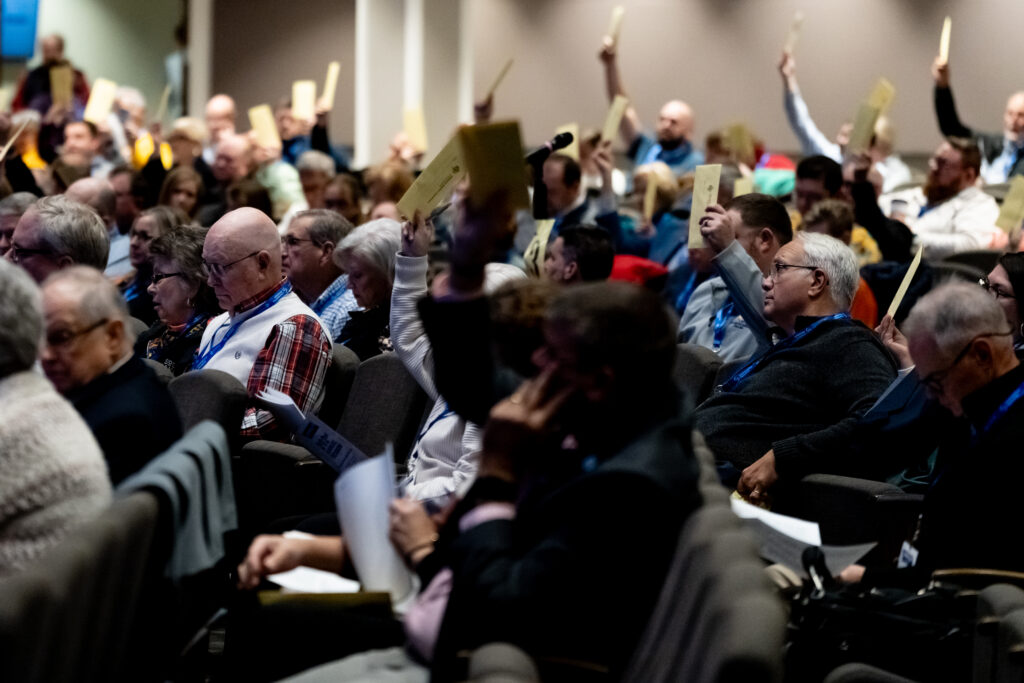
The meeting will focus on a convention name, constitution and bylaws and setting in place a leadership structure, organizers told about 350 people from more than 100 Missouri Baptist churches attending an information and planning meeting Jan. 17 at First Baptist Church, Sedalia. The church’s pastor, Drew Hill, is one of the organizers.
Others on the agenda were former Missouri Baptist Convention (MBC) Executive Director Jim Hill (brother of Drew Hill) and H.K. Neely, vice president for denominational relations and dean of the Courts Redford School of Theology for Southwest Baptist University, Bolivar. Neely noted he was not attending the meeting as a representative of SBU.
Jim Hill — who neither confirmed nor denied that he would consider being executive director for the new convention — said, “The Baptist convention today is not the same one I have known all my life. The emphasis is on power and control. However, I do not desire to give up my heritage as a Baptist.
“It is time to quit fighting with fellow Baptists and move forward with the Kingdom work,” he said. “Those no longer … welcomed in the MBC can form a new Baptist state convention and continue our heritage.”
The meeting organizers emphasized that a new convention would plan to affiliate with the Southern Baptist Convention (SBC).
Drew Hill said, “Some of the churches … give to the Cooperative Baptist Fellowship, but most are loyal to the SBC. We are going to be respectful of … who they align with and where they … send their missions dollars.”
Churches in the new convention could align with more than one national convention. This would allow 17 predominantly black congregations in Kansas City to be dually aligned with the National Baptist Convention and the SBC — which they currently cannot do.
Neely also noted that “many churches are reluctant to give up their relationships with our missions organizations.”
But MBC leaders said they are astonished and skeptical that moderates forming a new state convention — many of whom have been among the SBC’s most vocal critics in recent years — now want to be in “friendly cooperation” with the SBC.
The reversal in attitude by the moderates, some of whom recently referred to SBC supporters in Missouri as “the Taliban,” was underscored as one of the proposed “core values” of the proposed new convention.
“I’m shocked,” said Bob Curtis, MBC president and pastor of Ballwin Baptist Church, Ballwin. “This is ridiculous. I think if they are going to cooperate with the SBC, then there is no reason to leave the MBC.”
Roger Moran, research director for the Missouri Baptist Laymen’s Association, said, “They define friendly cooperation by simply forwarding money collected from churches that join their convention. They despise the SBC’s six seminaries and the Ethics and Religious Liberty Commission.”
“This is not a fringe, radical movement by a bunch of wild-eyed people,” Drew Hill said. “It is a heartfelt concern on the part of solid, loyal Missouri Baptists.”
Jim Hill noted that the 104 churches invited to attend the planning meeting have more than 107,000 members. “That is one out of six Missouri Baptists,” Hill said. “That would mean a new convention would be the 21st-largest of the 41 state Baptist conventions.”
Those 104 churches also represent a total of $4 million in giving to the Cooperative Program (CP). Hill projected that if 200 churches — about 10 percent of MBC churches — joined a new convention, then a CP goal of $6.675 million would result in $2.3 million going to SBC causes. “That would place this convention 16th on the list of SBC support,” Jim Hill said. “If we reached that $6.675 million, we could also completely replace the funds that the five institutions [whose boards voted to go self-perpetuating] lost. Ten percent of the MBC could financially support those five institutions and still have operational money to serve the churches that we are members of.”
The five institutions where boards of trustees voted to go self-perpetuating are The Baptist Home, Missouri Baptist College in St. Louis, Windermere Conference Center, Missouri Baptist Foundation and the Word & Way news journal. Messengers to the MBC annual meeting last October voted to place more than $2.2 million in CP giving to those entities in escrow until they rescind their actions.
The matter is leading to possible litigation.
(BP)


Share with others: