
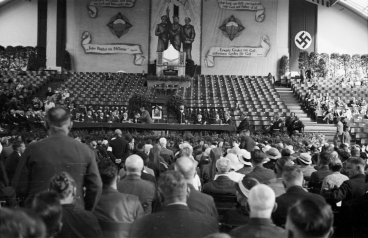
The 80th anniversary of a courageous stand by Christians in Germany who opposed Adolf Hitler also marks a sad chapter in Baptist history that festered four decades before Baptists voiced repentance.
In contrast to Christians who resisted Nazi evils, German Baptists “were just happy to have the regime allow them to preach the gospel within their churches,” historian Albert Wardin said. “And so the German Baptists were not going to take any position that would counter any of the positions of the Hitler regime.”
Meanwhile a diverse conglomeration of Christians from several denominations — called the “Confessing Church” — issued what came to be known as the Barmen Declaration, a 1934 document stating that Jesus, not Hitler, was Lord of the Church and condemning false doctrines espoused by the Nazi-controlled state church. Some declaration supporters lost their lives.
German Baptists, however, initially viewed Hitler as a champion of religious liberty and his military conquests as a providential expansion of their field for evangelism.
When Hitler and his National Socialist Party came to power in 1933 he appeared to be a friend of Christians. Secretly though, he believed Christianity was nonsense because its message of repentance and humility contradicted the National Socialist agenda of ruthlessness and strength.
But before Hitler’s true beliefs were known Germany’s Protestant federation agreed to establish a national church sympathetic to the Nazis.
“German Christians” — as members of the national church were called — attempted to purge Christianity of elements deemed “too Jewish.”
Many professing Christians in Germany saw no incompatibility between their faith and the Nazi-controlled church. But a group of believers — including theologians Karl Barth and Dietrich Bonhoeffer — recognized the errors of Nazi ideology and formed the Confessing Church to protest.
The high water mark of the Confessing Church was the Barmen Declaration. The declaration rejected the “false doctrine” of German Christians that “the State … should and could become the single and totalitarian order of human life, thus fulfilling the Church’s vocation as well.”
But according to German theologian Erich Geldbach, “The German Baptists, in their effort to achieve social respectability and to avoid being forced into a homogenized national church, failed to recognize that they were being used.”
Fraternal relations between Baptists and Nazis extended beyond a Baptist World Alliance Congress meeting in Berlin in 1934. Although German Baptists suffered persecution for 100 years before Hitler’s rise, Nazis used the police to protect Baptists from harassment and granted them good locations for ministry.
But when Baptists realized Hitler’s true plans and became victims of persecution themselves, the opportunity to take a meaningful stand had passed. Three Baptist pastors were sent to prison or concentration camps, according to one count, and many experienced persecution.
Individual Baptists confessed their complicity with Hitler following the war. But not until 1984 did German Baptists formally express regret that they failed to support the Confessing Church.
“Recognizing the evil at the beginning was more difficult than it appears today in retrospect,” Germany’s Baptists said at a European Baptist Federation Congress in Hamburg. “At that time … there were among us those who detected the real nature of that regime, who warned against it. … Nevertheless we did not publicly join … the sufferings of the Confessing Church and failed to withstand more consciously the violations of divine commandments and injunctions.”
Southeastern Baptist Theological Seminary professor Nathan Finn said all believers should seek to emulate the Confessing Church’s courage in the face of moral challenges. He cited religious liberty and defense of traditional marriage as issues on which such courage is needed today. (BP)



Share with others: