
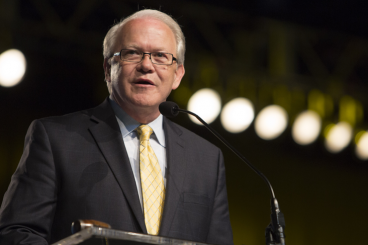
A $186.5 million Cooperative Program (CP) budget, an amendment to the mission statement of the North American Mission Board (NAMB) and a name change for Golden Gate Baptist Theological Seminary were among the recommendations affirmed by messengers during the Executive Committee’s (EC) report to the Southern Baptist Convention (SBC) on June 16 in Columbus, Ohio.
Messengers confirmed an update to the SBC constitution regarding qualifications for churches to send messengers to the annual meeting. Messengers also approved a recommendation to approve the use of electronic voting but rejected the EC’s suggestion of removing the need for a quorum for voting on matters of business.
The 2015–16 CP Allocation Budget of $186.5 million designates $136,518,000 (73.2 percent) of that for world missions, $41,328,400 (22.16 percent) for theological education, $3,077,250 (1.65 percent) for ethics and religious liberty ministries and $5,576,350 (2.99 percent) for the SBC operating budget. The International Mission Board (IMB) is slated to receive $94,014,650 of the world missions budget; NAMB, $42,503,350.
NAMB ministry change
Messengers approved an amendment to NAMB’s ministry statement to include planting churches overseas in agreed-upon instances with IMB.
The amendment is similar to an amended IMB ministry statement in 2011 to allow IMB to assist with unreached people groups in the United States and Canada. EC members were told during their February meeting that the amended NAMB statement will relate particularly to military chaplains stationed at bases overseas.
Golden Gate Seminary
Messengers voted to approve a name change for Golden Gate Seminary to Gateway Seminary of the Southern Baptist Convention. The vote was the first of two required to confirm the name change. Messengers at the 2016 SBC meeting will give final approval. The change is part of a transition process to move the main campus of the seminary from Mill Valley, California, to Ontario, California.
Messengers
Messengers gave the necessary second-year approval to officially revise qualifications for churches to send messengers to the annual meeting.
The proposal to revise Article III — with additional recommended adjustments to Article 14 and SBC Bylaw 8 — was a response to a motion from the 2013 annual meeting in Houston that requested updating messenger qualifications. All of the amendments took effect at the end of the 2015 annual meeting.
Before the change, Article III stated that churches in friendly cooperation with the convention could send one additional messenger for every 250 members or for each $250 per year “paid to the work of the convention.” The $250 amount dates back to 1888.
Under the new proposal approved by messengers, each cooperating church that contributes to convention causes during the preceding fiscal year will automatically qualify for two messengers. One additional messenger can be added for each $6,000 the church contributes in the preceding year through the normative combination of the CP, designated gifts through EC for convention causes and/or to any SBC entity. And churches can now send up to 12 messengers rather than 10.
Messengers overwhelmingly approved the recommendation.
Electronic voting
The results of a vote on SBC bylaw amendments to allow for electronic voting devices in the convention hall was delayed during the business session June 16 when a proposed amendment to the recommendation from the floor went to a ballot vote. The amendment passed and messengers approved the recommendation June 17 after voting to strike a portion of the EC’s recommendation that removed the quorum requirement.
The EC’s recommendation defined a quorum for voting on SBC business as those present at the time of a ballot, but messengers rejected that definition and left in place the minimum 25 percent of those registered requirement.
Electronic voting is only for messengers present in the convention hall. Voting by proxy is not permitted.
William Blosch, of Georgia, said allowing a quorum to be based on those present at the time of a ballot left room for too few informed messengers to be present to vote.
In its February meeting, EC reported electronic voting could allow the ability to schedule elections closer together and be more efficient in annual meeting programming.
Also during EC’s June 15 meeting prior to the convention, the committee found Weatherly Heights Baptist Church, Huntsville, is not in friendly cooperation with SBC.
(BP, TAB)


Share with others: