
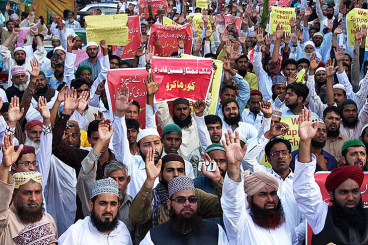
A Supreme Court decision to uphold the death sentence for an Islamist who killed Punjab Gov. Salman Taseer because of his objections to Pakistan’s blasphemy laws signals government resolve against Islamic extremism, human rights advocates said.
On Oct. 7 the high court upheld the October 2011 death sentence for Mumtaz Qadri, who as Taseer’s bodyguard shot him to death in Islamabad on Jan. 4, 2011. Qadri said he killed Taseer over the governor’s outspoken opposition to Pakistan’s blasphemy laws and his public support for Aasiya Noreen (Asia Bibi), a Christian mother of five who was wrongly convicted and sentenced to death for blasphemy.
Qadri’s execution likely will be seen as a key moment in Pakistan’s attempt to combat Islamic extremists following the Dec. 16, 2014, Taliban massacre of more than 130 schoolchildren in Peshawar, which prompted the government to scrap an informal moratorium on the death penalty.
“This is just the beginning,” said Rufus Solomon, a Christian politician from the opposition Pakistan Tehreek-e-Insaf. “The Supreme Court decision is a very strong sign that the state is trying to recover the space it ceded to violent extremists.”
Solomon said he hoped the ruling also would reverberate in acquittals in cases of blasphemy accusations motivated by personal rivalries or monetary disputes. Bibi’s case grew out of an argument with her fellow field workers in which anti-Christian prejudice was clearly evident.
First step
“I have a strong feeling that Asia Bibi and all other innocent Christians who have been subjected to the blasphemy laws will be freed by the Supreme Court,” Solomon said.
Saroop Ijaz, head of Human Rights Watch in Pakistan, said in a statement that upholding Qadri’s murder conviction was a “brave decision” and “the first step in introducing some rational discourse on blasphemy.”
The chairperson of the Human Rights Commission of Pakistan, Asma Jahangir, said the ruling “sent a very clear message that the court will not give in to external pressures.”
The court decision runs against avid support for Qadri, whose supporters are calling for the execution of Bibi before the government proceeds with his execution. Public support for Qadri at the time of the murder was so great that then-army chief Gen. Ashfaq Kayani reportedly told Western ambassadors he could not publicly condemn Qadri because too many soldiers sympathized with the killer.
‘Rule of law’
Taseer’s daughter, Sanam, said that even though she opposes the death penalty in principle, she would welcome Qadri’s execution because she thinks the verdict was “wonderful for the country because it shows there is rule of law.”
Qadri enjoys special prison perks and has recorded best-selling albums of devotional songs. In 2014 he was found to have incited a prison guard into attempting to kill an elderly British citizen held in the same building for alleged blasphemy.
Qadri’s defense contended that in accordance with Islamic jurisprudence he was obligated to kill Taseer because the governor had committed blasphemy by criticizing the blasphemy laws, an argument the Supreme Court was compelled to consider.
Justice Dost Mohammad Khan, 1 of 3 judges on the Supreme Court bench, said, “We have to look into whether the deceased [Taseer] indeed committed the act of blasphemy or he commented adversely on the effects of the blasphemy law.”
In a late-night protest outside the Lahore Press Club on Oct. 7, Pakistan Sunni Tehreek activists shouted chants against the three justices that upheld Qadri’s death sentence.
The only thing now standing between Qadri and execution is an appeal for a presidential pardon, which few expect to be granted.
(MS)


Share with others: