
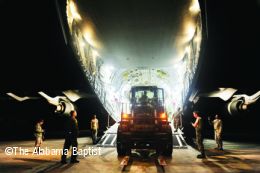
Katie Snider’s day already looked a little like a scene from a movie.
The Samford University senior was sitting next to a well Jan. 12 at a children’s home in Haiti — a country and people she had “fallen in love” with back last summer and couldn’t wait to return to this January. She and Samford junior Megan Scott were washing, scrubbing, wringing out clothes and chatting while they worked.
And then it happened.
The trembling started, the water in the well started rising and sloshing and in a heartbeat it all crescendoed into a 7.0 magnitude earthquake the whole world heard.
All Snider and Scott could hear was children.
“We were both surprised and didn’t know what to do. We heard the kids running out of the cafeteria screaming,” said Snider, who attends Shades Mountain Baptist Church, Vestavia Hills, in Birmingham Baptist Association.
The children were safe — all 70 of them at Canaan Orphanage. But 40 miles down the road at Port-au-Prince, life had turned bleak in a way that was unfathomable just seconds earlier.
The capital city was in ruins. Countless buildings crumbled, schools collapsed on children and the death toll soared in the tens of thousands. Bodies lined the streets, and survivors — many injured — walked around aimless, in shock.
The world looked on in horror.
And in the moments and days since, thousands have spent frantic hours trying to contact family members unaccounted for in Haiti — even Alabama Baptists.
“My niece Becca Rose is on a missions trip in Port-au-Prince and we cannot contact her. She is 15. Her parents are freaked out,” Lisa Chilson Rose, director of church and community ministries for Montgomery Baptist Association, wrote on Facebook just after the quake.
Becca was found safe.
But for many other loved ones, that hasn’t yet been the case.
At press time, the Florida Baptist Convention had yet to make contact with 18 of the 21 employees the convention has living in Haiti as part of a partnership with the nation.
 “They are like our family,” said Craig Culbreth, director of Florida’s Partnership Mission Department who has traveled to Haiti for the past 11 years. Florida Baptists have a 15-year partnership with Baptists in Haiti and have helped plant 890 churches during that time.
“They are mothers, fathers, sons and daughters and they are hurting right now,” Culbreth said. “Many of them have small children. Some of their homes may be damaged and they are sleeping in the streets. It is a desperate situation there.”
At press time, Culbreth planned to lead an assessment team of Florida Baptist Convention staff members to Port-au-Prince the weekend of Jan. 16 to learn the condition of the convention-owned guest house and employees.
And still more Baptists are facing questions and heartache.
Biene Lamerquea, a prominent Baptist pastor in Port-au-Prince, died in the earthquake, and still others are unaccounted for, according to Gedeon Eugene, a vice president of the Baptist Convention of Haiti.
Many other pastors and church members are homeless and in dire need of provisions.
“They are starving,” Eugene said. “You can imagine their urgent need. They cannot cook, they are thirsty, they are injured. The children and old persons are more fragile.”
Different Baptist groups are already stepping up to the plate to help meet those immediate needs. The International Mission Board is collecting money for relief efforts through its Web site, and Baptist World Alliance has already made an initial $20,000 pledge to help Baptists in the affected area.
And Mel Johnson, disaster relief strategist for the Alabama Baptist State Board of Missions (SBOM), is encouraging Alabama Baptists who want to help to give enough for a bag of rice.
“We are being flooded with phone calls,” Johnson said. “Our churches have a heart. They see what’s taking place on the news — staggering death toll, unimaginable suffering — and they want to help.”
The best way for them to do that, he said, is to donate to disaster relief work through the special Web site set up for Alabama Baptists: www.alsbom.org/haiti.
“There will be regular updates on the Web site on the work going on in Haiti, and it is also very easy for them to give through the Web site,” he said. “We need to address immediate needs, and $20 will by a 100-pound bag of rice. The funds will be 100 percent destined for the greatest need.”
As far as sending volunteers is concerned, Alabama Baptists are “waiting in the wings” for now, Johnson said.
The Florida Baptist Convention and Southern Baptist disaster relief leaders are “flying the flag, and we are coming along and getting behind them,” he explained.
 At press time, a Southern Baptist assessment team was set to visit Haiti the week of Jan. 18, in addition to the Florida team planning to head in just before. Teams will communicate back to state and national disaster relief representatives and work to get logistics in place for long-term, collective efforts.
“As it stands now, short of assessment teams we (Southern Baptists) have no one going in until secure lines of transportation are firmly established,” Johnson said. “It has to be done very methodically and intentionally for us to help in the best way we can help.”
One issue facing volunteer teams is that serious security concerns could emerge as people become more desperate for food and water in areas where police and military control has not been established, said Jim Brown, U.S. director for Baptist Global Response. The capital’s main prison also collapsed in the earthquake, raising the prospect of criminals escaping into the city.
At press time, military personnel and search and rescue organizations were on the ground working in the area. Until logistics are nailed down and arrangements secured, a number of trained Alabama Baptist disaster relief volunteers — including the state’s airlift kitchen team — are waiting on alert, Johnson said.
For now, he is urging Alabamians to consider donating to Baptist relief work rather than thinking of going or donating items.
“The lines of shipping are sparse at best, so shipping goods to the people of Haiti is not a good option right now, though it may be a possibility later down the road,” Johnson said.
Until then, Baptists can give monetarily, as well as pray and prepare.
“Our greatest opportunity will come over the long haul,” he said. “We will have the opportunity to ease suffering as well as have a wonderful, wonderful gospel witness there.”
The SBOM has already sent an initial check for Haiti relief, according to Rick Lance, SBOM executive director.
“On behalf of Alabama Baptists, your State Board of Missions has already sent an initial check of $50,000 to the Florida Baptist Convention,” Lance wrote on his blog, www.ricklance.com. “More, much more, is needed and Alabama Baptists will respond to this devastating situation as we have during the aftermath of the storms and other tragedies of the past.”
And state Baptists will continue to respond, he noted.
“The long-term strategy is much more involved. When the green light is given to us, Alabama Baptists will respond with trained disaster relief personnel to be sent to Haiti. Long after the news spotlight has shifted elsewhere and many relief agencies have departed, the yellow shirts of Alabama Baptists and other Southern Baptists will be on the ground working in recovery, restoration and rebuilding,” Lance wrote.
More than four years after Hurricane Katrina, state Baptists are still investing in relief and rebuilding work in Mississippi and New Orleans, he added. “The same will most likely be true in Haiti. Some of the hardest work comes after the days, weeks and months following such a traumatic disaster.”
To give to Baptist disaster relief work in Haiti, visit www.alsbom.org/haiti and click on “donate” to donate by credit card, or send a check to State Board of Missions, Attn: Accounting Services, P.O. Box 11870, Montgomery, AL 36111-0870. Mark the check “For Disaster Relief.”
(BP, BWA contributed)


Share with others: