
While college students at the University of Alabama, Pat Terry and Gail Hill shared a deep connection to missions work. “I always had thought Gail and I were twins separated by birth because our stories are so similar,” said Terry, a member of Dawson Memorial Baptist Church, Birmingham, and professor of nutrition and dietetics at Samford University in Birmingham.
Terry, who was drawn to missions at an early age, was appointed as a Baptist Student Union (BSU) (now Baptist Campus Ministries, BCM) summer missionary to Iowa while in college.
Hill, a member of Baptist Church of the Covenant, Birmingham, and a professor of nursing at the University of Alabama at Birmingham’s School of Nursing, also felt that same call to missions work at the age of 12. In addition, she developed an interest in Israel at a young age. “Whereas most teenage girls had pictures of movie stars and rock stars [on their walls], I had maps of Israel,” she laughed.
Hill said she never imagined that she would actually serve in the country. “My father had died when I was very young and my mother was raising two children — we didn’t have very much,” she shared.
After interviewing for summer missions service in 1969 through the then-BSU in Tuscaloosa, Hill thought she would be sent somewhere in the U.S. But she was astonished when she discovered she had been chosen to go to Israel. “I … felt that it was truly providential,” she remarked.
In 1972, a second opportunity arose for Hill to return to Israel and serve for the summer.
When Terry spotted the Israel missions opportunity on a BSU bulletin board one day, she decided it was where she wanted to next serve.
So Hill and Terry embarked to Israel the summer of 1972 to serve on a missions team guided by Norman Lytle, a missionary through the Foreign Mission Board (now International Mission Board) who was living in the country at the time with his family.
It was the same summer a devastating terrorist attack occurred at Lod Airport (now known as Ben Gurion Airport) near Tel Aviv, Israel (see story, page 12), and another occurred against Israel’s Olympic athletes in Munich.
Hill and Terry traveled separately, and Hill recalled arriving in Israel one day before the attack. “I arrived on May 29 in Lod Airport, and the very next day was this horrific event,” she recounted. Twenty-six people died in a terrorist attack at the airport by three Japanese Red Army agents.
Seventeen of those killed were Puerto Rican Christians who had traveled to Israel for a biblical pilgrimage.
In the days and weeks following the attack, members of the missions team made ministering to and visiting with some of the Puerto Rican survivors a major focus of their work. They made weekly visits to the hospitals and found numerous ways to encourage those healing from the incident.
Some of the uninjured survivors stayed at a hotel close to the Jerusalem House Student Center, where Terry and Hill’s team served that summer with Lytle and his wife, Martha.
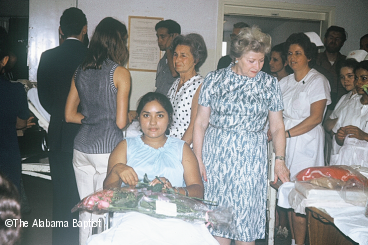
Terry remembers visiting with Puerto Rican survivor Pastor José Franqui, who had lost his wife in the gunfire. When she and others from the missions team went to visit Franqui, he had just acquired his wife’s belongings. He shared the story of how a small Bible in his jacket pocket at the time of the attack had stopped what could have been a deadly bullet.
“He showed us his Bible that had saved his life,” Terry recounted. “And then, this is the most memorable thing, he asked us to sing his wife’s favorite hymn together, and it was ‘How Great Thou Art.’ And of course he was singing in Spanish and we were singing in English, and [another team member] … was singing in Arabic. Every time I told the story in churches, I would say, ‘This is what heaven is going to be like because we’re all going to be praising God in our own languages.’”
Another survivor Terry and Hill remember was a woman named Olga who had lost both of her legs in the attack. Terry and others ministered to Olga in the hospital and organized a 21st birthday party for her.
“We helped plan a birthday party for her in August, and we took her a nativity scene from Bethlehem,” Terry recounted.
One of Hill’s most vivid memories of the trip was riding in the van when she arrived on May 29 and traveling “up to Jerusalem.” “Jerusalem sits way up on a hill,” she noted of its ascent. “The very next day [after the attack], we went down … into the depths of the grief of all these people, and I remember the comparison.”
Terry and Hill’s team remained in the country despite the attack and went on to serve at the Jerusalem House Student Center that summer. “It was a lovely home at one time that had been purchased by the Baptists and renovated to some extent to be a place for [college] students to come,” Hill shared of the ministry.
While there, the team completed various work projects on the grounds. They also made themselves available to talk with the visiting students, play games and share stories.
This was not an experience that became a distant memory as soon as the women returned home. The events of the summer and those they had ministered to remained in their hearts and on their minds.
“For years I showed my slides of Israel in a lot of churches, and those pictures of the Puerto Rican people were always in there,” Terry said.
Both women’s missions journey eventually led them into full-time missions service. Hill was later appointed as a missionary to India, where she served four years as the director of nursing for a Baptist hospital. Terry was appointed as a missionary to Venezuela where she served for 11 years.
And now they both work in the health-related academic field, teaching at universities, both in Birmingham.
On May 30, Terry attended a 40th anniversary remembrance ceremony in Puerto Rico that honored the Puerto Ricans who were killed and injured in the 1972 attack (see story, this page). During her visit, she was able to reunite with the Lytles and others she met in Israel that summer, including Franqui.
“I was able to tell the survivors we had known and their families that when I showed the slides of Israel, I always talked about what happened [that summer] and asked the people in the churches to pray for them,” she said.
To view a video related to this story, visit the video library.


Share with others: