
It took six days for Southern Baptist disaster relief specialists from Alabama and South Carolina to gain access to Japan’s tsunami- and earthquake-stricken Tohoku prefecture.
It took only a few minutes, however, for John Hayes, of Birmingham, and Eddie Pettit, of Sunset, S.C., to understand the intense fears surrounding the nuclear crisis and how it affects disaster response.
Hardly anyone was at the airport when they arrived March 19. With no traffic, the bus trip into town took only an hour, a ride that normally takes two or more. Even pedestrian traffic at the busiest crosswalk in the country only boasted 15 to 20 people wearing surgeon’s masks. Normally this corner is a sea of hundreds dressed in black business suits, jockeying for space to cross the street.
Despite living more than 200 miles from the failing Fukushima nuclear plant, Tokyo residents stayed home, creating a “ghost town” like atmosphere. In the city of almost 13 million people, most ventured out only to purchase bottled water and toilet paper.
“The fear of radiation is really the biggest obstacle in responding to Japan’s disaster,” Pettit admitted. “It’s not only affected the Japanese but it’s dominated the media and created fear throughout the world.
“We have to convince the people in the States that it’s safe to work here,” he added. “I want Southern Baptists to know that the radiation scare is a lot worse in the States than it is here now.”
Tokyo and surrounding areas slowly come back to life three weeks after the nightmare began. People go back to work and restaurants reopen. The fear, though, is still hidden just below the surface. It comes out in simple things like wondering if the fruit or vegetables you buy came from Fukushima or if the tap water has radiation contamination.
The possibility of radiation is always in the back of people’s minds, especially when Tokyo Baptist Church (TBC) sits around a table dreaming up ways it can respond to this triple disaster. Hayes and Pettit consult with the church on ways to launch a disaster relief ministry.
Every idea put on the table immediately gets thrown into the “do later” pile as team members grapple with how to handle the nuclear crisis. It seems like a major roadblock to every ministry possibility until Hayes quietly pulls out something that looks like a credit card. He peels back the red plastic and points to the blue dot on this small radiation detection card called a dosimeter.
“Look! I’ve been wearing this ever since I arrived in Japan, and it hasn’t registered any radiation exposure levels yet,” Hayes said, noting that all International Mission Board (IMB) personnel and their children were issued a card to measure their exposure to radiation, allowing them to return to their ministries and homes. “Volunteers will wear one of these cards at all times, too. We want everyone safe while they are ministering in this disaster.”
Having a way to measure radiation exposure changes the climate of the meeting. It goes from “what will we do in the future” to “let’s do something now.” The timing could not have been better. The very next day, Japanese government restrictions to most areas of the disaster zone are lifted. TBC immediately sends the team trained by the disaster relief specialists in one direction, and Hayes and Pettit go another. All leave with a dosimeter hanging around their necks, offering a sense of safety but not invincibility.
Pettit said the long wait to actually visit some of the disaster area for assessment is not normal. In other natural disasters, Southern Baptist disaster relief responds immediately and hits the ground running. In Japan, it’s been three weeks since the earthquake and tsunami, yet they just now make their first assessment. The radiation fears have a little to do with this delay; the main reason is government restrictions, not to mention the lack of gasoline.
“The developing countries do not have a disaster plan or the infrastructure that Japan has,” Pettit said, explaining how important it is to work within the Japanese system and not just respond in the same manner as they did in Haiti. “Each disaster is different and this one is three disasters in one: earthquake, tsunami and radiation fears. It doesn’t matter how long it takes us to get established; there is going to be plenty of disaster work for a long time.”
Any fears of radiation are quickly forgotten as Hayes and Pettit survey an area safely outside of the 30-mile radiation zone suggested by the United States.
The magnitude of this disaster and the need for future work sink in as the pair walks down the streets of Ishinomaki. Despite the Japanese government forces working round-the-clock since the quake, the destruction is still overwhelming, a stark contrast to the normally pristine and orderly Japanese lifestyle.
Hundreds of cars pile up at odd angles. Some stack on top of each other three or four high. Boats sit stranded and busted on side streets and open lots. Ships lean to one side on wide-open roads. Seven-foot high walls of trash line streets outside homes filled with a foot of mud.
Entire neighborhoods are still without electricity or kerosene. Nearly 23,000 people are in shelters, and thousands more shiver in damaged and waterlogged homes. People sit in the cold all day and night. A snowstorm and cold front hit northeastern Japan just hours after the tsunami.
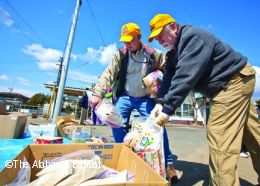
The pair see many ways Southern Baptist disaster relief teams can work and minister, filling in cracks left behind by the government forces: mucking mud, feeding hot meals to people and distributing supplies. They stop to talk to a family who owns a kimono store destroyed by floodwaters.
“We need to help get the mud and debris out of the houses. That’s pretty labor intensive,” Hayes said. “It might seem small to us, but it will plant a seed. We can show the love of Jesus Christ and make a difference.”
Pettit and Hayes quickly teach some IMB representatives how to properly muck out the kimono shop. As Hayes bends over to help, his dosimeter swings out from under his jacket. The Alabamian nonchalantly glances at the exposure reading and then quickly tucks it away. Nothing registers. He wonders about the TBC team just 15 miles down the road.
The TBC team members work diligently, remembering everything Pettit and Hayes taught them. They prepare 3,000 hot meals a day in a neighborhood without electricity and no access to relief supplies. Every two hours, the team leader diligently checks her dosimeter.
Nothing registers, giving them confidence to continue ministering and lead two people to Christ. (BP)
Share with others: