
It’s hard to believe there is an American who wasn’t inundated with TV images of devastated Haiti in the days right after the Jan. 12 earthquake.
But Jack Frazier is that guy.
Oh, he saw the first few images of horror and heartbreak on his TV in North Carolina, but that was all it took for him to want to quit watching.
So that’s just what he did.
And within hours, Frazier — along with four other North Carolina Baptist Men and two Baptists from Hungary — boarded a plane headed south.
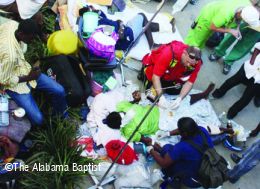
Before the week was out, he was standing in an overcrowded hospital in Port-au-Prince, the nation’s hard-hit capital, being careful about where he walked to keep from stepping on the multitude of injured people lying on the ground.
“They were lying just about anywhere you could put them. We wanted to treat them with dignity, but you were doing good to find a piece of cardboard to lay them on,” Frazier said. “It was very chaotic.”
For days, he and the other members of the Baptist World Aid (BWAid) Rescue24 International Team split up to work round-the-clock shifts caring for patients who had been waiting for days to have injuries treated.
“I can’t even imagine how many patients we touched while we were there,” Frazier said.
And the team did the work with very little equipment, scrounging around for whatever would work.
“We had a pretty significant need for supplies by the end of the week and no food or water at all,” Frazier said. “We knew based on observation that we would treat a patient and then they would wait one or two days on the ground and in the meantime, had no food. These people have just been through the ringer, and we can’t even put food in their bellies.”
This kind of heartbreak is faced often by the team, a group of specialized Baptist volunteers based in Hungary and spread around the world from Singapore to North Carolina.
The team, made up of firefighters, doctors, paramedics, trained rescue personnel and even two rescue dogs, aims for getting into a devastated country within 24 hours of a natural disaster. Among the team members, there are even those who know alpine rescue techniques and have diving capabilities.
“We meet once a year and train together,” said Gaylon Moss,volunteerism/disaster relief coordinator for North Carolina Baptist Men, noting that his organization got involved with the team after the Indonesian tsunami in December 2004.
When things happen in other parts of the world, North Carolina Baptist Men respond. And when something happens on this side of the world — like in Haiti — North Carolina takes the lead.
“When the earthquake happened, within three hours, we were on the phone with our North Carolina partners,” said Bela Szilagyi, director of Hungarian Baptist Aid. “The next morning, two Hungarians were on an airplane.”
Oftentimes the team’s focus is search and rescue — such as in India, where it saved 13 from the ruins of an earthquake.
But in Haiti, the focus was medical instead, though Szilagyi said the team had second thoughts about that. “With all the previous experiences we’ve had, we thought at first it would be too late (by the time rescue workers could get into Haiti),” he said. “But now we realize it would not have been too late.”
But being the first international medical team to arrive at the small hospital still brought relief in a profound way. “They (hospital staff) couldn’t treat them all because there were more and more coming,” Szilagyi said. “And eight or nine days down the road, there were still patients coming who had not received any medical treatment before. Some had to walk several days to get there.”
All in all, it was a “heart-shaking experience,” he said.
Paul Montacute, director of BWAid, the relief and development arm of Baptist World Alliance (BWA), said it’s a significant ministry for Baptists. Because of BWA’s relationships worldwide, the team has been among the first to enter affected countries after major disasters. “It’s an important initial response that we can make, to have teams with expertise in medical matters and search and rescue in place within 24 hours of an emergency in the world,” Montacute said.
Szilagyi agreed. “Baptists have always been good to provide disaster relief as far as food, water, shelter and construction have been concerned. But it was a dream and a vision (of Hungarian Baptists) to provide this initial response,” he said. “When you have a disaster or tsunami or flood, there are always two stabs that need to be addressed — one is saving lives and one is saving lives with medical attention.”
Share with others: