
Southern Baptists are at the forefront of an effort by faith-based organizations to combat a social evil in which people are sold into slavery multiple times, according to Laura Lederer, senior advisor on trafficking in the U.S. State Department’s office for global affairs.
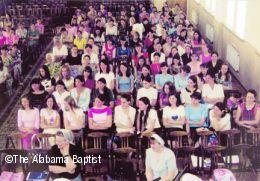
Lederer, who spoke to more than 200 participants at the Preventing Abuse Conference on Human Trafficking and Child Abduction — the first-of-its-kind conference in Los Angeles — told Baptist Press, “Baptists are at the forefront of legislation in D.C. They have been strategic in policy-making.” The Nov. 9 conference convened to “educate, motivate and activate” society and pastors in the Los Angeles area.
Lederer, the featured speaker who is considered an expert on the topic, said faith-based and nonprofit organizations are “at the grass-root level of this issue,” which President George W. Bush has described as one of the worst offenses against human dignity.
An estimated 600,000 to 800,000 women, children and men are impacted every year by human trafficking, which is defined as modern-day slavery, according to the State Department’s office to monitor and combat trafficking in persons.
Trafficking victims are trapped in forced labor and sexual exploitation, and millions of people are enslaved in their own countries.
Don’t be fooled into thinking this type of activity occurs only in Third World countries, warned Kumar Kibble, an immigration and customs enforcement officer with the Department of Homeland Security. “This summer we arrested a ring where 100 girls from Korea were being held in forced prostitution in San Francisco,” Kibble said at the conference. “Over 1,500 trafficking victims in Los Angeles and 400 in Orange County have been rescued in the past two years.”
Southern Baptists have been working to stop human trafficking since the late 1990s. “Right now our efforts are focused on public policy, such as the End Demand Act [S. 937, H.R. 2012] that focuses on prostitution’s demand,” said Barrett Duke, The Ethics & Religious Liberty Commission’s vice president for public policy and research, from his Washington office. “Our focus is on the pimps and johns, because the need for the demand needs to be addressed.”
In addition to working with others to aggressively prosecute these criminals, Duke has plans to work with the State Department’s trafficking in persons office to develop ways Southern Baptist pastors can be more aware of the issue.
“We are currently identifying pastors in key areas that we can visit with to show how to recognize victims and develop a system to get them out of slavery,” Duke said. “In most of our churches, somebody knows or has come in contact with a victim and doesn’t even know it. We want to raise awareness.”
In the United States, the key areas to raise awareness in are densely populated cities such as Los Angeles, Houston and Phoenix, said Duke, who sits on the National Coalition for Religious Freedom and Human Rights.
As seen in the recent Lifetime Television miniseries based on real trafficking scenarios and starring Mira Sorvino, women are often promised waitress jobs or modeling jobs with high pay and then are forced to work in brothels or strip clubs or as nannies or maids.
This occurs in countries around the world such as Moldova, where Woman’s Missionary Union (WMU) has been addressing the issue of human trafficking and sex slavery on the side of the victims, said Jean Cullen, WMU missions involvement specialist and coordinator of International Initiatives.
She noted that WMU has a partnership with Moldova and as part of that, has developed some ways to address the human trafficking that is so prevalent there. “This is one of the major issues that (churches) are dealing with, with their teenagers and young women,” she said.
WMU is reaching out through the churches, holding seminars on sex trafficking and starting Acteens groups. Cullen said in Moldova, Acteens serves as a forum for teens to share their experiences and be educated about sex trafficking.
“We want to educate these girls on the realties of sex trafficking, that these job opportunities are not legitimate,” she said.
Microbusinesses are another way WMU helps victims of trafficking, Cullen said. Through WorldCrafts, WMU buys handmade items from artisans in countries worldwide to sell in the United States.
She noted that some of the items are made by women who are trying to escape prostitution or trafficking. WorldCrafts provides a livelihood and skill for these women.
Global Women, based in Birmingham, is fighting human trafficking through projects similar to WorldCrafts and programs to educate women in the United States.
Global Women is currently partnering with Project HOPE, based in Prague, Czech Republic. Project HOPE focuses on helping Bulgarian Gypsy women escape living on the streets.
The women learn how to knit scarves that are sold by groups such as Global Women, according to Meg Olive, student coordinator for Global Women.
She said Global Women is coordinating a project to make kits to be distributed to the Bulgarian women. The group also provides prayer support to Project HOPE and is coordinating a 2006 summer missions trip to Prague, Moldova and Romania to work with trafficked women.
Olive said Global Women also supports a ministry called Freeset Bags based in India that provides an alternative income for women in the sex trade there.
Trafficking can happen anywhere, experts said. “It is a profit-driven enterprise,” Kibble said. “It’s most lucrative because people are a commodity that can be sold over and over again. It’s an industry in the shadows, so the numbers are hard to estimate.”
Johnny Gosch was a victim in 1982 at age 11, when he was abducted by kidnappers in Des Moines, Iowa, while on his newspaper route.
“He was sold to an organized pedophilia ring where rich pedophiles hire people to kidnap children and then purchase them to molest,” said Noreen Gosch, Johnny’s mother, who told the story at the conference. Johnny visited his mother many years later in the middle of the night. He told her he had escaped from his captors and was living undercover for fear of being killed, she said.
“We can’t stick our head in the sand and say this is too ugly,” Gosch said. “Evil can only be allowed if good men and women do nothing.”
Gosch and others have worked to introduce legislation to stop this type of trafficking across the country.
For more information on how to identify victims of human trafficking or how to help, call a nationwide hotline at 1-888-373-7888 or visit www.cedarsfoundation.com or www.bsccoalition.org. (BP, TAB)



Share with others: