
Sixty-six “poor urban settlements” — some small, some enormous — bump against Nairobi’s sleek, downtown skyline like moths circling a light bulb.
Kibera, a 6-kilometer-long expanse of tin-roofed shacks following the railway, is home to 1 million people — one of the largest slums in the world. Mathare counts at least 500,000 people. Dandora surrounds a city dump that stretches as far as the eye can see.
These urban settlements contain more than half of the 4 million people (some say 5 million) in Kenya’s capital city, but they occupy only part of the urban landscape.
Extensive middle-class and upscale communities lie west of Nairobi’s central business distric. Nairobi is the economic, political and cultural capital of East Africa. Most multinational corporations, nongovernmental organizations and Christian missions groups involved in the region base offices there. Nearly every African language is spoken in Nairobi; nearly every major African people group is represented.
“We have sides of town that are Muslim and Christian,” observed a Southern Baptist representative. “There are areas where little pockets of countries live, like Eastleigh. Nairobi has every religion you can find in the world: Hindu, Buddhist, animist, African traditional religions, Christianity, hundreds of cults.”
Nairobi’s size and importance are remarkable considering the city didn’t exist a little more than a century ago. It was born in 1899 on swampy Maasai tribal land as a way station for the railroad built by the British from Mombasa on Kenya’s coast to Lake Victoria in Uganda.
Today it is a roiling cauldron of peoples, cultures and classes. The city counted about 350,000 residents when it became the capital of a newly independent Kenya in 1963. The population has multiplied at least tenfold since, a source of its vitality and its growing problems.
Unemployment hovers above 50 percent. Crime grows increasingly violent and brazen. The wealthy take cover in gated communities, while the poor have no such option.
“The biggest challenge for the city is so many young people with nothing to do,” Southern Baptist representative Jerry Stephens said. “So they find something bad to do.”
Christian missions has long focused primarily on rural Kenya. Still Nairobi has many vital evangelical churches. Kenyan Baptists count some 60 congregations in the city. But Nairobi has grown too large and chaotically diverse for its existing churches. They are “dwarfed by the degree of lostness,” Southern Baptist representative Doug Lee said. “You take those 60 churches and add up their attendance and it’s just not even beginning to have an effect on this large city.”
Another problem: 80 percent of all Kenyans claim to be “Christian.” But the mile-wide, inch-deep nature of their Christianity was revealed by the bloody intertribal violence after the December 2007 elections. Most of the killing unfolded outside Nairobi, but more than 100 people died in the city. Thousands more were driven from their homes.
“Where were the ‘80 percent’ of ‘Christians’?” Baptist leader Shem Okello asked. “‘Christians’ were burning churches.”
In Nairobi, the number of self-identified evangelicals is about 16 percent, according to Lee. Partnering with Kenyan Baptists, the International Mission Board’s metro missions teams are working to reach the rest, including university students, the business class, Asians and slum dwellers, the majority of the population.
“We realized that a tenth of the whole country now lives in Nairobi,” Lee said. “We’re not going to win the country until we win the city.”
The key to winning Nairobi, added Stephens, “is discipleship. We’re not going to reach this city without mature believers.”
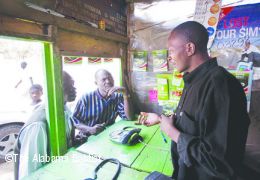
Believers like William Ochienga, who sells mobile-phone minutes from a kiosk near a busy roundabout in Baba Dogo, another of the city’s sprawling slums. “Everyone around here knows me,” he said, and he knows everyone.
He came to faith in Jesus through “T4T” (Training for Trainers) teaching. Now he closes his kiosk once a week and opens a tiny room in back. There he teaches the stories of truth so others may teach in turn. (BP)
Share with others: