
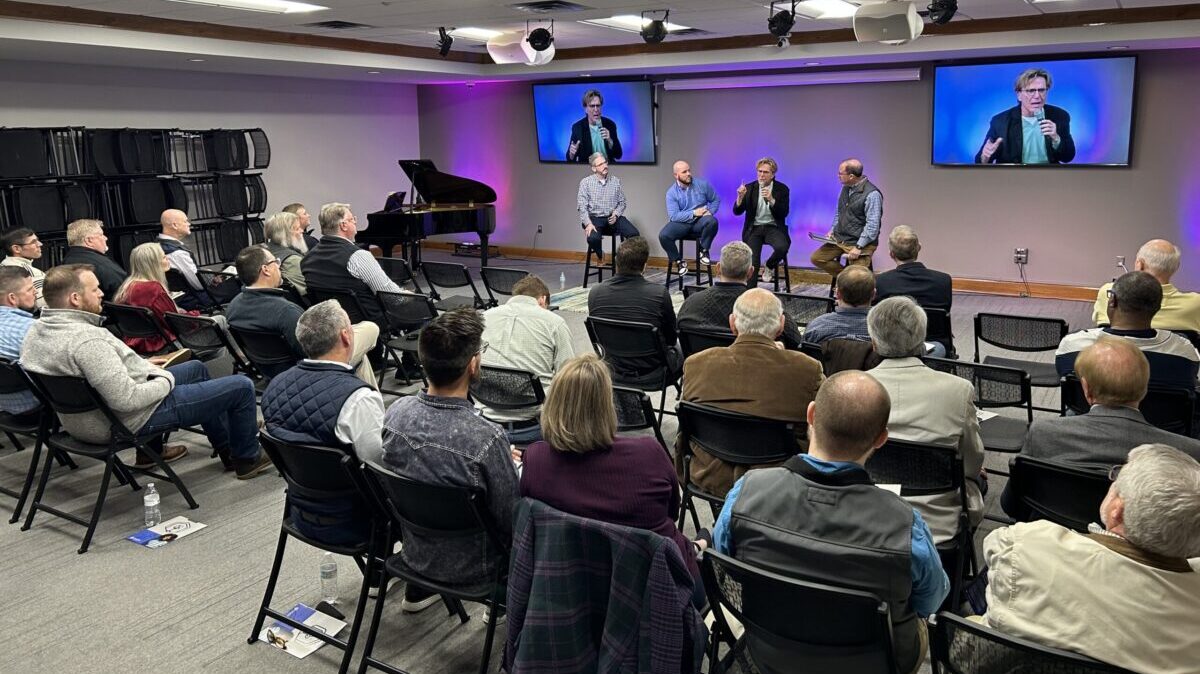
The relationship between the senior pastor and the worship pastor is a critical relationship, according to Chip Colee, chief administrative officer of Alabama Baptist Children’s Homes and a former worship pastor, and he believes the congregation picks up on this when there are issues.
“My former pastor, Jay Wolfe, used to say that ‘it’s hard for God to work across a broken wire.’”
Colee served as panel host for “What Worship Pastors Wish Pastors Knew,” a pastors meeting held at the Birmingham Metro Baptist Association facility in Birmingham on March 20.
Brad Jett, minister of worship arts at Hunter Street Baptist Church, Hoover, agreed that sometimes there is brokenness in ministry, but the overriding mindset must be delight in the “privilege of sharing a platform” and leading worship.
“I know my pastor carries a heavy load, and my job is to be supportive,” he said. “I don’t want to be an extra burden. I respect his time, so when I ask to see him to talk about my plans, I have three or four ideas written to talk about and don’t try to overwhelm him with a long list.”
Michael Adler, dean of worship for the STS Institute in Homewood — a ministry of the Scott Dawson Evangelistic Association — said that most pastors are in a “driven mode,” and the task of the worship pastor is to support them whether there’s a lot of collaboration or only a few minutes spent in coordinating worship ideas.
“I’ve heard pastors say they’re challenged when they come to the pulpit after a moving hymn or choral piece, but I tell them, ‘We’re on a trajectory with you,’ and we ‘feel the room’ together. The music and message blend together to honor the Lord. For example, if the congregation sings a moving rendition of ‘How Great Thou Art’ before the message, the pastor might just say, ‘Isn’t God great?’ and then turn to his Scripture. The music brought everyone to a good place, so he doesn’t need to start with his intended Bugs Bunny joke.”
‘More than music’
Collin Clardy, engagement specialist for ABCH, directed Voices of Mobile, the traveling vocal ensemble of the University of Mobile, and said many young people had the idea that “worship” means “music.”
“That’s a false idea, and I taught them a different way,” he said. “Worship is more than music. All the elements of worship must honor the Lord as we seek to work together.”
Clardy said that sometimes pastors can be more introverted and spend a lot of time with their books and in their studies.
“I must respect the pastor’s personality but still try to reach out to him for direction,” he said. “Sometimes the relationship can be more 80-20 on my part, but it’s my job to try to coordinate my plans with his wisdom and vision.”
On another topic, Colee said the task of choosing appropriate music is daunting.
“There was a time when the sharpest theological minds of our denomination chose the best hymns for us and published them in the ‘Baptist Hymnal,’” he said. “But today we have more sources for worship music, though we have yet to choose that which is theologically sound.”
Adler said he’s known church leaders who wished to discard particular music due to the failures of the writer or the sponsoring organization.
“Many (writers and composers) have made their mark, and then some have screwed up,” he said. “I believe they still made their mark, and I take time to explain why I find value in some of this work. This kind of honest discussion is helpful as we plan our music selections.”
Contributors talked about changes in worship order and how it happens sometimes at the last minute.
Jett told about a time in another church when the pastor announced that Jett would sing during the Lord’s Supper.
“That was the first time I’d heard this!” he said with a laugh.
“I opened the ‘Baptist Hymnal’ and sang my heart out. I suppose we all have stories of last-minute challenges.
“It’s OK to have changes, and I know the pastor may feel the leading of God in a particular moment,” he said. “I tell my pastor that I can change quickly, but if others are helping me and have rehearsed, it’s different for them.”
Four principles
Colee concluded the panel with four principles for worship leaders.
One, if you want to be respected, be respectful.
“Just because someone says they’re creative doesn’t mean they can be neglectful,” he said. “Have your stuff together, be on time and dress like you’re supposed to.”
Two, you can’t take the people where you’ve not been.
“Worship leaders should grow as disciples. They should read books on leadership. We must be good examples of growth in our spiritual and mental lives.”
Three, be fluent in other relational languages.
“I think it’s good for worship leaders to have hobbies or follow sports and do things others do in order to relate to them as real people.”
Four, you’re not the pastor.
“The worship pastor is not called to be the pastor, so he must work with the pastor,” he said.
“If God calls you to be a pastor, that’s fine. Go to seminary and get prepared. But you won’t be pastor of that church. We must respect the office of pastor and never undermine the church’s mission. That is darkness.”
The remaining pastors meeting schedule for the Birmingham Metro Baptist Association is posted at bmbaonline.org/ministers-conference.



Share with others: