
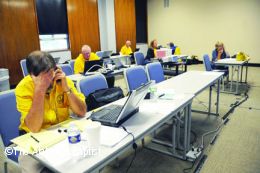
Vernon Lee stares at a computer screen chock full of information about disaster relief volunteers. To his right sits a stack of papers he looks through several times an hour. To his left stands someone who needs to ask a question. Large posters taped around the walls demand his constant attention. At that same moment, Lee’s cell phone rings. Sound stressful? Welcome to the job of the commander of the Alabama Baptist disaster relief Incident Command Center (ICC).
When hundreds of tornadoes struck the state on April 27, Alabama Baptist disaster relief volunteers sprang into action, and one of their first steps involved setup of the ICC in Montgomery. The Baptist Building’s chapel provided an ideal location for the command center because of the resources already there.
The ICC leadership team, which is made up of volunteers around the state, was en route to Montgomery within hours of the storms hitting.These are “experts who have distinguished themselves in faithful service to Alabama Baptists through many disaster relief deployments,” said Mel Johnson, associate in the Alabama Baptist State Board of Missions (SBOM) office of global missions and strategist (state coordinator) of Alabama Baptist disaster relief ministries.
Executive Director Rick Lance also mobilized all state missionaries to assist in the effort, both with the ICC and across the state. State missionaries were deployed to every area affected by the storms to encourage pastors, directors of missions and the thousands devastated by the tornadoes. They also helped wherever and however they could as they traveled from site to site.
And so under the direction of Johnson and Lance, the ICC came to life by midday April 28.
The initial team consisted of Lee, a member of White Springs Baptist Church, Rainbow City, commander; Ron Warren, a member of First Baptist Church, Ashville, cleanup/recovery; and Kyle Jeffries, a member of Faith Baptist Church, Athens, feeding units.
John and Fran Baughman, members of Vaughn Forest Baptist Church, Montgomery, oversaw the administrative duties; Jay and Penny Isbell, members of Beth El Shaddai Messianic Synagogue, Bessemer, coordinated communications; and Michael Mims, a member of First Baptist Church, Wetumpka, and Wellman Lim, a member of First Baptist Church, Prattville, operated the ham radios.
Along with coordination of trained disaster relief volunteers, the ICC also operated a phone bank during the first two weeks of disaster relief efforts. The phone bank was staffed by SBOM ministry assistants. As calls came in, they were referred to the appropriate office for processing.
Jeff Hammack, coordinator of computer services for the SBOM, made sure the ICC’s technology needs were met.
Bins of telephones and computers designated for disaster relief and stored in the Baptist Building were brought to the ICC almost immediately, he said.
Within a few hours, 20 computers were in place with wireless connections, a telephone bank was operational and ICC personnel had access to a projector, hundreds of feet of wires and cables and ham radios.
And so the state disaster relief leaders as well as disaster relief coordinators from other state conventions and the North American Mission Board worked together in the ICC.
“The Incident Command Center exists not just to coordinate resources but also to coordinate with other states and other relief agencies such as the American Red Cross,” Johnson explained. By bringing everyone to one location, resources can be coordinated and maximized and face-to-face meetings can be held daily to ensure everyone is on the same page, he said, noting 11 state conventions from 10 states are helping with the disaster relief effort.
Lee added, “All of our state disaster relief coordinators have received Homeland Security and FEMA (Federal Emergency Management Agency) training, in addition to disaster relief training.
“We preplan for disasters so that we will know exactly what we need to do when a disaster strikes.”
And while Johnson directs all disaster relief efforts in the state, he spends most of his time out in the field assessing needs. The ICC commander stays in the command center to direct the operation as well as the rest of the volunteer team. Each member of the team has a specific assignment for which he or she is responsible and guides the work in that area by placing volunteers where there are needs. As needs change, volunteers are moved from one location to another.
With work starting early each day and lasting late into the night, ICC volunteers are encouraged to transition about once a week. The team members worked off and on for more than a week with Lee being the last to hand off his duties May 9.
Tommy Puckett, retired state disaster relief coordinator, took over as ICC commander, and Johnson shifted some of his time back to the command center.
Reggie Quimby and Scotty Goldman from the SBOM office of global missions also absorbed more responsibilities from the ICC as volunteers returned home and the command center was moved to their office May 13. Quimby and Goldman have assisted in various roles in the ICC since it was set up.
And with the phone bank being shut down, ministry assistants in the office of global missions will be handling the calls coming in related to disaster relief.


Share with others: