
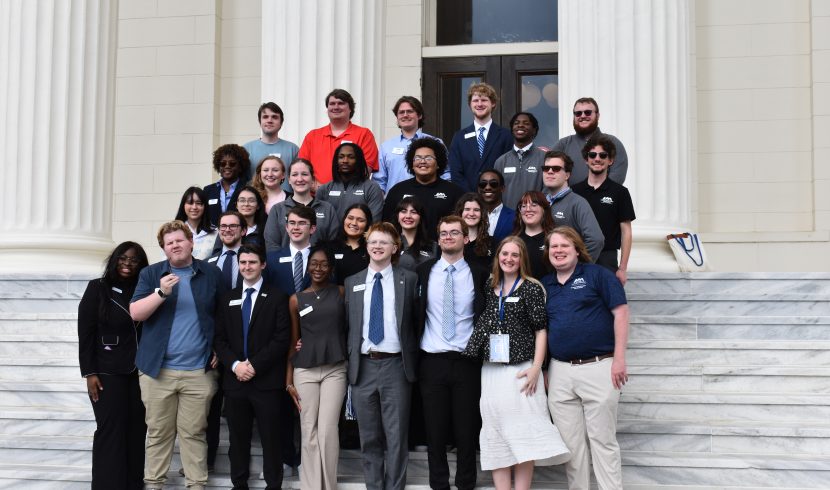
Vast multitudes live in spiritual bondage, with no idea of God’s love or the price He has paid for their freedom, 45 new overseas missionaries were told during a Sept. 15 ceremony at First Baptist Church in Roanoke, Va.
These missionaries are entering fields of service where oftentimes the growth of house church members outpaces the leaders for them.
International Mission Board (IMB) trustee chairman Tom Hatley told the group about a recent overseas trip, during which he met the leader of a large movement of house churches that had been growing at a phenomenal rate.
“He is instructing his people that, for the next two years, they are not to allow the churches to more than double each year,” said Hatley, who is pastor of Immanuel Baptist Church in Rogers, Ark.
“The reason for the slowdown is that they were growing so quickly and they could not train leaders fast enough to adequately staff the churches being formed. Without training for leaders, there was a danger that the movement would become weak and open to damaging strains of theological thought.
“The look of concern and frustration in that pastor’s eyes was painful to me,” Hatley said. “It was a cry for help that demands our immediate attention. It is a logjam that could threaten the future of many of our church-planting movements.”
Regional leaders and stateside staff are addressing the need, Hatley said, but he challenged trustees to “find a way to bring leadership to those groups that are experiencing exponential growth.”
“What is needed is exponential leadership training,” he said. “When we train leaders, we must train them to recruit and train other leaders and continue that pattern as long as is needed.”
Hatley also reported during an August meeting between IMB staff and trustee leaders and presidents and missions professors from the six Southern Baptist seminaries and Mid-America Baptist Theological Seminary in Memphis, Tenn.
The dialogue, held in Atlanta, gave seminary leaders an opportunity to share their perspectives about IMB strategies and offer ideas about ways closer partnership could enhance the ministries of both the IMB and the seminaries.
The all-day meeting was an outgrowth of concerns expressed last year by Keith Eitel, a missions professor at Southeastern Baptist Theological Seminary in Wake Forest, N.C., and Paige Patterson, president of Southwestern Baptist Theological Seminary in Fort Worth, Texas.
Hatley said the meeting was “very helpful.”
“The purpose was to discuss ideas and concerns about work on the field, how we can make it better and more theologically sound and how we can more frequently involve our seminaries,” he said.
“The results were even greater than I had expected. Clarity was given to many issues, very constructive ideas were offered and were received with grace.”
Mutual respect
“Everyone exhibited the highest levels of Christian deportment and mutual respect, yet no one held back,” Hatley said. “There was an openness and freedom that allowed each concern to be expressed. It was obvious that everyone in the room had the same heart for spreading the gospel of our Lord.”
Presidents and missions professors were present from all the seminaries except New Orleans, where a previously scheduled faculty event prevented
participation.
IMB staff leadership was represented by President Jerry Rankin, executive Vice President Clyde Meador and Ron Wilson, associate vice president for leadership and ministries development.
The board was represented by Chairman Tom Hatley, Vice Chairman Michael Barrett of Pleasant Garden, N.C., Bob Pearle of Fort Worth, Texas, and John Floyd of Collierville, Tenn.
Barrett presented the trustees with a set of 10 recommendations that were being referred to the appropriate trustee committees for action in consultation with staff.
Among the recommendations were calls to:
-review the training, number of required hours from the seminaries and the particular courses required for missionaries who will serve as strategy coordinators,
-clarify the boundaries and levels of cooperation with “Great Commission Christian” groups,
-continue to evaluate missionary training on subjects such as church planting movements, ecclesiology and the role of women in ministry and
-revisit and clarify the definition of a local church.
(BP)



Share with others: