
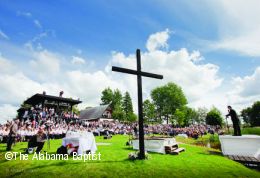
They were persecuted so severely that they couldn’t even gather in their homes to worship God. So they met in the forests, kneeling to pray in the snow of the Latvian winter. By the time they had finished praying, the snow had melted under their knees. They rowed boats 125 miles to the nearest church to be baptized, for which they were beaten and imprisoned and had their houses confiscated.
Peteris Sprogis, president of the Latvian Baptist Union, is proud of this heritage of faith handed down from the earliest Latvian Baptists 150 years ago.
“It really was a movement of the Holy Spirit among some people who were starting to read their Bibles, pray and experience Christianity and Christ in a new way,” he said.
Sprogis and other Latvian Baptists are praying to continue that legacy in the former Soviet republic and inviting Alabama Baptists to join in the work.
Baptists are a tiny minority in Latvia today, perhaps 7,000 out of a total population of more than 2 million. Many of the 88 Baptist churches are very small and sit in seaside fishing villages, which were the birthplace of the Latvian Baptist movement but now are being deserted by people moving to the cities.
Despite this, Sprogis sees God working to change things in the country.
“What we see happening is that God is starting to orchestrate a church-planting movement,” he said.
Latvian Baptists have set a goal to plant 100 churches, especially in Latvia’s cities and towns. Sprogis said some towns with as many as 50,000 people currently have only one small Baptist church.
“I think in some cases, there is this idea that the church is like an embassy, where you have one and that’s enough,” he said. “We need to think of churches more like hospitals, where we need as many as possible because we know the world is not well.”
Central to the church-planting movement is the Baltic Pastoral Institute (BPI), which is the Baptist union’s school for training pastors and church planters. Since its founding in 2007, the institute has trained a number of pastors who now are leading existing churches and planting new ones.
But Sprogis knows the task is enormous, so for the past four years, he has been visiting the United States to develop partnerships with churches to help support church planting. He came to Alabama in mid-September.
Sprogis said churches can partner with Latvian Baptists in many ways, including sending short-term missions teams and long-term church planters.
“I am looking for churches that would want to adapt and work alongside of our existing and future church-planting teams,” he said.
Sprogis also hopes to find professors and pastors who will teach for a period of time at the BPI.
In addition, money is needed for scholarships to help students attend, he said. Although 70 percent of all funds needed for the institute have come from Latvians, the global financial crisis has hit their country especially hard, Sprogis noted.
“We are looking for partners who will come alongside us, help this movement to develop and see what God has in store for us,” he said.
Sprogis wants Latvian Baptist churches to move out of survival mode — maintaining buildings and trying to keep enough people in church to pay the bills — and catch a vision to reach the entire country for Jesus.
“If it’s not our desire to reach out and become a movement, it’s tragic,” he said. “I think sometimes people settle for too [little]. If the church starts to believe that it finds its value in itself and starts to protect itself, that’s when the church becomes our idol and we stop reaching out.”
Monte Erwin, who was a Southern Baptist representative to Latvia with the International Mission Board from 1996 to 2002 and still visits every year, said the time is ripe for a church-planting movement to catch fire in the country. Many Latvians have lost everything in the sluggish economy, and he thinks they may be realizing they cannot put their trust in riches.
“There seems to be an emerging need for the spiritual again, and some are discovering that their hopes are fulfilled in Christ,” said Erwin, a member of Lakeside Baptist Church, Birmingham.
Erwin also detects a new sense of enthusiasm and spiritual sensitivity among Latvian Baptists that he describes as “striking.” He sees this community of believers much like its country, small in size but tenacious — and never to be underestimated.
“This little country led the way in becoming one of the first Soviet states to declare its independence and move away from the Soviet Union at its own risk and peril,” Erwin said.
“Many were willing to give their lives for this cause as they barricaded themselves in the city of Riga and awaited the Soviet army to arrive. In my heart and mind, I wonder what God might do through these people.”
To find out more about the work in Latvia, e-mail admin@lbds.lv.
(Jennifer Davis Rash contributed)
To view a video related to this story, visit the video library.

Share with others: