
You’d probably hear them before you’d see them, and you’d know what to expect: leather, chrome and attitude roaring down the highway in a blaze of distinctly American glory. They’re blacktop bandits or concrete cowboys.
Besides perpetuating the stereotype of a biker, it’s seldom thought these often vilified flouters of convention are capable of more than intimidation and — let’s face it — delinquency.
But for nearly 30 years, the motorcycle subculture has been “infiltrated” by a steady stream of leather-clad, street-savvy gospel gangsters ready to bring a few of Hell’s Angels back to heaven where they belong.
“Not a club, but a ministry,” the Christian Motorcyclists Association (CMA), headquartered in Hatfield, Ark., has been preaching across the pavement since the 1970s.
They wear the same style, speak the same language (with the exception of a few four-letter words) and ride the same bikes as their secularly-titled counterparts, but CMA’ers ride with a higher purpose and only instill the fear of God.
Pat and Wendell Legg, members of First Baptist Church, Gardendale, are living proof.
This husband and wife team is serious about motorcycles.
They’ve been riding for 25 years and even met at a motorcycle rally. Little did they know that God would use the two-wheeled machines to get them riding down the path to Him.
“The CMA,” beams Pat. “That’s how we got saved.”
Wendell nods his head in agreement. “Yep, it was the direct result of a CMA evangelist coming out to these events.”
That evangelist was Southern Baptist preacher Tom Pitman, co-founder of the CMA.
“We didn’t even know he was a preacher,” Pat says with a laugh. “He would come around and be friendly with you and get close to you, and then he’d say, ‘I’m an evangelist. I’m doing services Sunday morning, and I’d like you to come.’ We got to feeling guilty because he was being such a nice guy, and we weren’t going,” she continued.
Pat, 55, rides a Yamaha Birago 1100. Wendell, 59, prefers a Suzuki F31500 Cruiser.
Despite these differences, the two go together like Harley and Davidson.
After their salvation, the couple quickly rose in the CMA ranks, first heading up Birmingham’s local CMA chapter, known as The Son’s Dixie Riders, and eventually they became Alabama state coordinators from 1988 until 1994.
“Now we’re back to just being members,” says Wendell, noting that they both remain active. “It’s wonderful to see God work, and [see that He’s] still working.”
Pat explains that bikers, as often neglected and even shunned elements of society, inevitably see a couple of their own as more approachable than your average-looking — i.e., car-driving — Christian.
“Wendell had a bike with a big mural of Christ on it the way Revelation describes Him. They’ll see that or see the CMA patch on our jackets,” Pat said.
“We met a truck driver in a diner once and started talking to him after he asked us a question. As we all went to leave, we stopped and led him to the Lord, standing right there in the door.
“We’ve ministered to people at rallies who didn’t even know Jesus was a real Person. It’s just all about servin’ the Lord, reachin’ the lost, and the CMA opens doors,” Pat said.

Weekend review: Oregon school shooting and ‘unimaginable loss’; homeschool mom sues; German churches want child-friendly AI
Grab a cup of coffee, and check out these headlines from the week reported by The Baptist Paper.
Stevens reminds students about Christ’s love demonstrated, defined and displayed
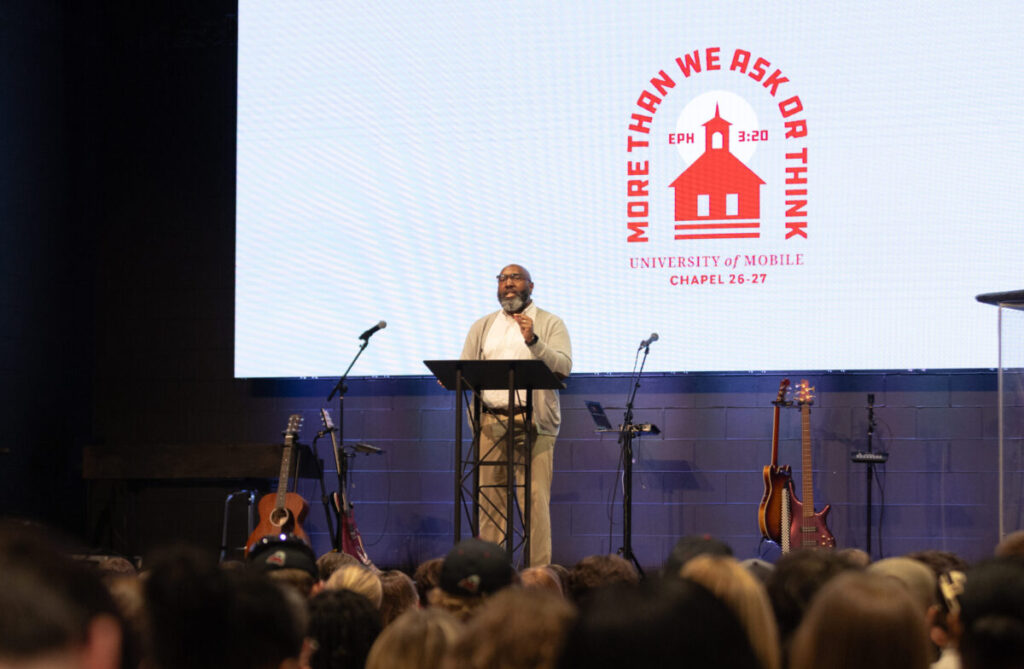
During University of Mobile chapel on September 30, students heard from one of their own as Joe Stevens delivered a compelling and convicting message about what love truly means while preaching out of 1 John 4:7-11.
Alabama community college enrollment tops 100,000 for 1st time since 2010
The Alabama Community College System announced Wednesday (Oct. 14) that the latest enrollment figures show 100,262 students are attending a

Homes, cafes, apps used by missionaries to spark gospel conversations
Across Spain, people looking for connection and meaningful conversation turn to the internet to find groups where they can meet
Share with others: