
The public has a few weeks left to review proposed K-12 social studies and arts textbooks before the Alabama Board of Education votes on which to approve for statewide use. The public review period runs through Nov. 12.
The textbook adoption process is one that State Superintendent Eric Mackey described as legally sensitive and tightly controlled until the board votes Nov. 13.
RELATED: Check out more stories on faith and culture from Ken Lass.
Subscribe to The Alabama Baptist today!
Members of the public can view all social studies and arts textbooks under consideration at select libraries statewide.
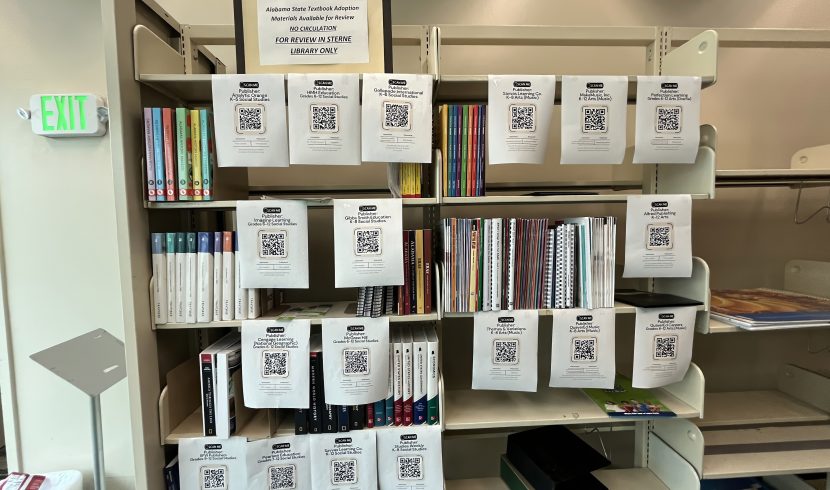
At the UAB Mervyn Sterne Library in Birmingham, Alabama Daily News found the review process looked different than in previous years. Only a few dozen physical copies of textbooks for both subjects combined were on the shelves, whereas in previous years, physical textbooks crowded those same shelves.
Instead of textbooks, most publishers provided QR codes with usernames and passwords to access materials online.
For social studies, there were a dozen QR codes that were supposed to take users to online textbook materials. At least two publishers had physical textbooks and a QR code on display. Half a dozen publishers provided physical textbooks only.
On the arts textbooks, eight publishers provided QR codes. And there were a couple of library shelves filled with physical books.
Where the QR codes led was inconsistent, though. ADN found a couple of QR codes that were not working, and a few others didn’t take users to a suite of full textbooks online. However, some codes did take users to a complete display of textbooks under consideration.
Members of the public who want to comment on any of the textbooks at the Nov. 13 meeting must contact the department in advance.
The last social studies textbook adoption was in 2013, which was also the last time that course of study had been updated until new standards were approved in December. Arts textbooks were last adopted in 2017, with that course of study also revised last December.
‘We don’t control it’
At an Oct. 9 work session, Mackey reminded board members that while the Alabama Department of Education facilitates the textbook process, it does not control it.
“The textbook process is the only process that we, as a department and as state superintendent, we only facilitate — we don’t control it,” Mackey said. “By law, the textbook committee is the board’s committee, not a superintendent committee, and they report directly back to you.”
Two committees – one for social studies and one for arts – were appointed in April to evaluate textbooks submitted by publishers. Those committees met for months before submitting sealed recommendations to the board.
‘Tight-lipped process’
He described the process as “the most tight-lipped we have,” noting that members and staff swear an oath to secrecy.
“It’s the only one that carries criminal penalties for me and for board members if we don’t do it the right way,” he said.
“Remember that for textbook companies, these are multi-million dollar contracts, and if they get pushed out of a contract, and they think it’s because board members or the superintendent didn’t follow the law, they would, in a heartbeat, bring charges.”
The secrecy applies only until the board vote. Mackey said the board’s vote sets a baseline, not a ranking.
“Always remember that this is not choosing which one’s the best textbook,” he said. “It’s just setting a floor — so we weed out the ones that don’t meet state standards.”
After approval, school districts will have several months to review the options. Districts may purchase approved textbooks using state funds or select others not on the approved list, as long as those titles are not formally rejected by the board.
The textbooks and the new courses of study must be in place by the start of the 2026–27 school year.
EDITOR’S NOTE — This story was written by Trisha Powell Crain and originally published by Alabama Daily News.



Share with others: