
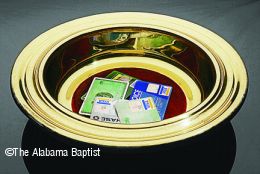
Small business owners who have been burned by bad checks have long responded by posting a sign above their registers: "In God we trust. All others pay cash."
Well now there’s a related message in many churches: "In God we trust. All others can use MasterCard, Visa or American Express."
And beginning this year, the Internal Revenue Service (IRS) also has a slogan: "In God we trust. All others show receipts."
A confluence of spiritual and secular interests is driving a change in the way religious communities raise money. On the way out is the traditional practice of church members reaching into their pockets and dropping bills and change in the collection basket on the Sabbath. On the way in are options such as automatic deductions from bank accounts and paying by credit card.
Churches hope the changes will woo young members used to a cashless society and will increase the overall take as worshipers become less arbitrary about what they give each week.
At the same time, the practices, which offer records of the transactions, will help churchgoers meet IRS rules for 2007 mandating receipts to address the gap between what some taxpayers say they give to their houses of worship and the amounts those religious communities actually receive.
This leap into a new financial world is raising questions for churches.
One, will the move away from dropping cash in the basket and incurring the fees associated with credit card use lead to an increase or decrease in overall revenues?
And two, is the offering the same theological experience when individuals make their choice a year in advance on a bank form or credit card as opposed to making a conscious decision each week, one that can be influenced by appeals from the pulpit or the guidance of the Holy Spirit?
Many observers think the move toward automated giving will give churches a budget boost.
"The advantages are fairly obvious in that it leads to more consistent giving," said Jim Swedenburg, director of the office of Cooperative Program and stewardship development for the Alabama Baptist State Board of Missions.
Many people want to give every Sunday or at least monthly, Swedenburg said, but if they miss church, then they are very unlikely to make that gift up. For some churches, preventing missed Sundays with automated giving "far offsets the cost of credit card fees," he explained.
Jeff Gilliam, financial administrator for Decatur Baptist Church in Morgan Baptist Association, said his church receives about $1,000 per week through online giving by credit or debit card. "It is working extremely well with very few problems," he said, noting that those who give online do so through a secure page on the church’s Web site. The church first made the option available two years ago.
Gilliam said the biggest concern is making sure online giving doesn’t just add another expense for families that have credit card debt.
"We put a statement on our online giving page that states, ‘Unless you are able to pay off your credit card each month, we do not advise you to use it,’" he said.
Another concern for some is the issue of keeping giving as an active act of worship, Swedenburg said.
There is a sense of community, not to mention accountability, when people place their offering in the collection plate before one another each week, said Sylvia Ronsvalle of empty tomb inc., a research organization in Champaign, Ill., that studies religious giving.
With electronic giving, the danger exists that church "becomes just another bill to pay," she said.
But Gilliam said that at Decatur Baptist, members are encouraged to see online giving as worship, too. On the church’s Web site, automatic withdrawal is not an option — an individual has to enter each gift separately.
"Yet we still have people who give just as faithfully online as they did when they were dropping a check in the offering plate," he said. (RNS, TAB)



Share with others: