
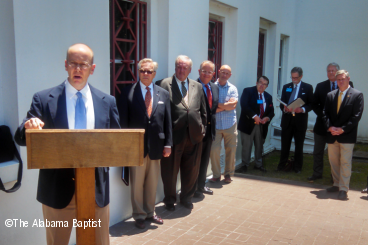
Gov. Robert Bentley announced July 19 that he is planning to call a special session of the Alabama Legislature in late summer or early fall to find funding for Medicaid, according to the Montgomery Advertiser. A possible solution to the $85 million Medicaid shortage is a state lottery.
Medicaid recently announced it would cut payments to doctors beginning Aug. 1, which would make up about $15 million of the shortfall.
But a state lottery is just 1 of 4 possible solutions for the state’s health care system. Other options include:
- Splitting the BP settlement for the 2010 Gulf oil spill.
- Transferring money from the state’s Education Trust Fund to the General Fund (this would be the second transfer of its kind, the first taking place in 2015 with $80 million).
- Creating new tax revenues, such as sales taxes and revenue transfers.
At press time, Bentley had not announced what options would be on the table during the special session, and simply said that proposals he’s made before — like those mentioned above — could be reconsidered, according to al.com.
Yasamie August, Bentley’s press secretary and National Governor’s Association coordinator, said in mid-July that the governor “is considering every possible option to alleviate the funding problems,” the Montgomery Advertiser reported.
In 2015 when the Legislature was considering a gambling compact with Poarch Band of Creek Indians to alleviate the General Fund shortfalls, Bentley shared with The Alabama Baptist (TAB), “I just don’t think we ought to fund government with gambling.” However, at the time he said that while he’s “totally opposed” to expanding gambling in the state, he believed an agreement with the Poarch Creeks might help the state budget and keep gambling at its current levels in the state. Much like now, Bentley called a special session to address the state budget and the proposed agreement with the Poarch Creeks died in that session.
If a state lottery is, in fact, Bentley’s current solution to Medicaid’s struggling budget, it would require state legislators to move fast. They would have to pass a constitutional amendment through both the House of Representatives and the Senate by Aug. 24 in order to get the measure on the November ballot.
If the measure were to pass in November, it could take a year or more to implement a lottery. And, as TAB previously reported, the revenue generated would not be nearly what gambling proponents claim (visit www.thealabamabaptist.org and search “Numbers in state legislation to form lottery, legalize casinos not adding up”).
A state lottery also could open up the floodgates for establishing casinos throughout the state. Although the Alabama Supreme Court has ruled time after time against electronic bingo gambling, a vote by Alabama’s citizens could change all of that.
Strange had no comment on the subject.
Joe Godfrey, executive director of Alabama Citizen’s Action Program (ALCAP), believes action on citizens’ parts is vital to remaining a gambling-free state.
Take action
“If pastors and church members do not contact their [representatives and senators] now and urge them to oppose all pro-gambling bills during the anticipated special session, we will be facing a lottery referendum this November,” he said.
ALCAP has a documentary available for churches about the ineffectiveness of state-sponsored gambling, titled “Out of Luck,” and Godfrey is available for speaking engagements on the subject. For more information, contact Godfrey at jgodfrey@alcap.com or 205-985-9062.
To contact your representative or senator, visit capwiz.com/state-al/home/.
—————————————————–
Seized bingo machines ‘stayed’
The state of Alabama will keep the more than 800 seized electronic bingo gambling machines it has a little while longer.
The machines were taken from Greenetrack Bingo and Racing in Greene County in a 2010 raid of the complex because they are illegal.
Greenetrack has been fighting to prove the machines are legal and former Jefferson County Circuit Court Judge Houston Brown ruled in June that the state had 30 days from June 22 to return the 825 gambling machines.
But Attorney General Luther Strange is appealing the ruling, so he filed a motion with the state Supreme Court on July 7 asking the Court to “stay the Circuit Court’s order so that it continues to have jurisdiction to adjudicate (make a judgment on) the state’s appeal.”
The state’s highest court granted the stay July 20.
While various sources report that Greenetrack’s lawyers are requesting the Supreme Court reconsider its decision, Brown’s ruling remains questionable.
It seems to go against the Supreme Court’s ruling in March that allowed the state to destroy more than 1,200 electronic bingo gambling machines it confiscated from VictoryLand in Macon County.
The Court said in its March 31 decision: “(This decision) is … hopefully the last chapter in the ongoing saga of attempts to defy the clear and repeated holdings of this Court beginning in 2009 that electronic machines like those at issue here are not the ‘bingo’ referenced in local bingo amendments.”
Policing the state’s gambling laws are left up to local law enforcement. Even though electronic bingo gambling is illegal in Greene County — and all of Alabama — Greenetrack continues to offer it. (TAB)


Share with others: