
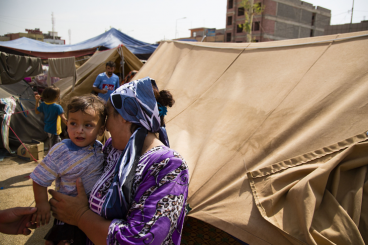
In northern Iraq people from every social stratum — attorneys and construction workers, rich and poor, educated and uneducated — huddle together in parking garages and unfinished buildings. Having lost homes and family members in Islamic State (ISIS) attacks, more than a million Iraqis have fled in desperation.
Nate Innis recently returned from a medical trip to nine refugee camps in northern Iraq. A veterinarian for many years, Innis followed God’s leading to become a physician and use his skills on the missions field. Though he expected to serve as a full-time missionary, God instead led him to do medical projects all over the world. He has now been on more than 60 trips.
These trips, however, represent far more than a medical opportunity. The northern Iraq crisis has created a unique opening to meet the spiritual needs of a desperate people by sharing the hope of Christ, which displaced Iraqis can then take with them as they return to their homes in places formerly closed off to the gospel.
Sharing Christ
“The medical part I love, but the spiritual part is truly the opportunity of a generation,” Innis said.
While Innis and his team treated a wide variety of ailments, from missing limbs to the common cold, most people simply needed comfort in the midst of a terrible situation. “They just wanted some assurance that they were loved and that they were OK,” Innis said.
On Innis’ last trip a physician came to him at one camp for a second opinion on his child, whom they diagnosed with cerebral palsy. Innis talked the man through what the future might hold, told him God cared about his child and prayed for the man and his family.
There also are believers in need, like Iraqi Christians, Kurdish Yazidis and other minorities, according to Abraham Shepherd, who leads Baptist Global Response work in the Middle East. They have taken refuge in tents, unfinished buildings, schools, highway underpasses and under tarps. They have endured scorching summer heat and harsh winter weather.
Many of them have heartbreaking stories to tell:
- In one village of 700 people, only three made it out alive.
- Children and old women were found abandoned in the mountains.
- A man carried his crippled brother for 16 hours with blood oozing from his foot.
- A man in his 60s, wearing pajamas, paced back and forth, asking constantly: “Where should I go now? What should I do? Can this happen? I worked all my life, with only a year left to retirement, and now without job income or pension. What can I do at my age?”
In addition to the threats and violence, the forcibly displaced families clearly have had no food for some time, Shepherd said.
“It shows on their tired, withering body with no energy left, with sagging face, dark rings around their eyes, and shrinking arm circumference noticeable among the children, a sign of being undernourished,” he said. “Yet with all of their needs for the basic necessities of life, they said to us as we are leaving, ‘If you find others in worse situations than us, please give to them, not us.’”
One member of Innis’ medical team, Lester Keegan, visited families in each camp to hear their stories and show them they had not been forgotten. At the end of each visit, he prayed with the families in Jesus’ name and many of them teared up at this simple gesture of kindness. Even his translator, a Muslim, said he felt the words of Keegan’s prayer inexplicably resonating within his heart as he translated.
Not only does this crisis provide new openings to share the gospel, but it also creates opportunities to train new and existing believers.
New opportunities
“They have no work to do, no job. They have nothing pressing their time. They’re hungry to learn and to praise God,” Keegan said.
This opportunity is not solely for Innis and his team, but for followers of Christ worldwide.
Innis said, “They really need our prayers and they need our support. They need to know that … God has not forgotten about them.”
David Platt, president of the International Mission Board, recently said in a video, “When you look at what’s going on in the world right now you see the needs of the nations as opportunities for God’s grace and God’s glory (to be) made known among the nations. When you think about Iraq … and you see what’s happening … these are massive humanitarian needs.”
The latest Iraqi offensive against ISIS began in early March. A senior U.S. Central Command official said the long-term aim is to regain control of the northern city of Mosul, the country’s second largest city, before the beginning of Ramadan in mid-June.
Platt said as the Church meets physical needs “amidst crises like these, we’ve got opportunities as a Church to step up on behalf of those who are in need in strategic ways through avenues like Baptist Global Response and, in the process, know that we’re fueling a much bigger picture of meeting people’s greatest need … for the gospel.”
Innis bids the Church rise to the occasion before it vanishes.
Ways to pray
- Pray refugees will have a chance to learn about the hope there is in Christ and that those who believe will have the opportunity to be discipled.
- Pray for more volunteers to go and work among refugees.
Where doors are closed to many others, health care professionals have unique opportunities to care, share, make disciples and empower the Church. (BP, IMB)
EDITOR’S NOTE — Names changed for security reasons.
For more information on how to help, email medicalmissions@imb.org. For more stories from Iraq, visit stories.imb.org/Eurasia.
The photos used with this story won the grand prize in the photo division of the Baptist Communicators Association’s 2015 Wilmer C. Fields Awards Competition.

Share with others: