
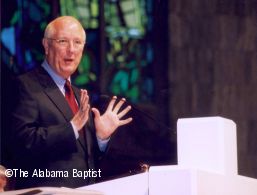
The 188th session of the Alabama Baptist State Convention was only minutes old when President Jimmy Jackson, senior pastor of Whitesburg Baptist Church, Huntsville, took what may prove to be the most important action of the annual meeting.
Jackson told messengers he had appointed a special committee to study “ways to better focus our resources 2011 through 2020.” He said the reason for the committee was to “help Alabama Baptists focus our resources and conduct Great Commission Ministries through the coming decade.”
When messengers accepted his report, along with the announcement of other committees appointed by the president, the state convention’s course of action was set even though many messengers may not have realized the importance of the action at the time.
“Ways to better focus our resources” is code for how Alabama Baptists will divide their missions gifts channeled through the Cooperative Program (CP). Will Alabama Baptists increase the percentage (42.5 percent) given to national causes? If so, then how? And what impact will this have on state ministries?
These and other similar questions were on the minds of many, if not most, of the 943 messengers who registered for the Nov. 16–17 meeting at Hunter Street Baptist Church, Hoover. They were asked in hallway conversations and informal discussions in the display area.
And they were asked from the convention floor. During the first opportunity to introduce miscellaneous business, two pastors offered motions that would move the convention to a 50–50 split of CP funds between state and national causes (see story, page 7). Both called for a study committee to recommend how to move to the new percentages. One went further. He asked the study committee to investigate all state entities and ministries to make sure they were aligned with Southern Baptist doctrinal and missional positions.
Messengers never discussed the motions. One was ruled out of order because it would bind future conventions — the 2010 annual meeting would be deciding budget percentages for future annual meetings. The other was judged moot because the special study committee mentioned above had been appointed earlier by Jackson.
What should not be missed is that the issue of how best to invest CP funds will be discussed. It will be discussed thoroughly, and recommendations will be brought to messengers for consideration. That is the responsibility of the special committee.
Rick Lance, executive director of the Alabama Baptist State Board of Missions, told messengers, “We are going to try to work with our Southern Baptist Convention (SBC) partners.” He added, “We have no intention of abandoning the ministries of Alabama Baptists as we look toward the future.”
Lance succinctly stated the dilemma facing state conventions. Does a state convention increase giving to national causes at the expense of state ministries, or does it focus on state ministries at the expense of national causes?
Recently some state conventions have opted to increase giving to national causes and cut back what is done in the state. Others have voted to continue valuable state-sponsored ministries while giving to national causes at traditional levels.
Alabama Baptists have chosen not to be rushed in making their decision. During the two-year study, the direction of the North American Mission Board (NAMB) will become clearer. Will NAMB phase out its work in Alabama, asking the state convention to invest more funds in state ministries? Will there be a comprehensive church-planting strategy? Will state conventions be asked to help support Baptist work in new work areas? What direction will the International Mission Board go? How will those decisions impact Alabama Baptists?
Much is unclear at this time. And because much is unclear, Alabama Baptists wisely chose to gather more information and take additional time to understand the implications of the information before committing themselves to a path different from the one they now travel.
While recommendations will be formed by the special committee, discussion about the issue will be statewide and involve people of every persuasion. That is the Baptist way. No one should be excluded from this important discussion.
That point was illustrated the day before the annual meeting when the state’s directors of missions (DOMs) adopted an open letter to Southern Baptists asking that the implementation strategies of the Great Commission Resurgence (GCR) be revisited before being put in place. With only one dissenting vote, the DOMs expressed fear that the strategies will have negative results on Baptist ministries and witness (see story, page 6).
Doubtless others will call for Alabama Baptists to immediately adopt all the GCR goals.
It also will be important to make sure things are done according to the Baptist way. One of the motions introduced called for a committee to study every Alabama Baptist entity and ministry to make sure they were aligned doctrinally and missionally with the SBC’s positions.
Ensuring that state convention entities and ministries stay true to the purposes for which they were founded is the responsibility of the trustees and directors elected by Alabama Baptists to oversee them. Trustees and directors also are charged with keeping the entities and ministries supportive of Alabama Baptists’ goals.
For a motion to be offered that implies a special committee is needed to do the task given to trustees and directors is unfortunate.
A word about participation. The 943 messengers who registered for this annual meeting is 15 percent below the 1,104 who registered last time the convention met in Birmingham. The total continues the downward trend from 1,778 in Montgomery in 2000 to just over half that number this year.
The low turnout occurred despite the election of a new president, concern about the implications of the GCR for Alabama Baptists and potential controversy over the convention budget. Also meeting in the central part of the state (Birmingham area) typically produces a higher registration than when the convention meets in Mobile or Huntsville.
Perhaps it is the economy. Church budgets are hurting just as the budgets of church families are hurting. Still attention to the annual meeting’s role is in order.
How representative of Alabama Baptists is the decision of 943 messengers from 419 churches when we report 1.1 million members and only one out of eight churches send messengers to the annual meeting?
Lance was correct when he observed that the key to remaining a healthy state convention is cooperation. That includes the way decisions are made about our future as Alabama Baptists.
Share with others: