
Like most major building decisions, relocation can be quite an intimidating issue for church leaders and congregations to face.
Gwenn McCormick, former director of LifeWay’s Church Architecture department and author of “Planning and Building Church Facilities,” refers to this decision as one of the toughest questions with which many churches deal.
“It strikes fear in the minds of many pastors and church leaders,” he wrote. “Relocation is a word some churches shun like the plague. Few decisions create as much anxiety and uneasiness in the average congregation.”
Despite its negative perception, McCormick explained why many more churches are considering relocating:
–Rapid church growth and megachurch development.
–Sociological and demographic changes in the surrounding area.
According to McCormick, these changes may vary from industrialization to radical swings in demographics. “When a community becomes a high-crime area and people fear for their safety, relocation becomes attractive to some congregations,” he noted. “Motivating people to faithful church attendance is a real challenge in the best of circumstances, but when these other factors are injected, the task seems almost impossible.”
When a great deal of members at NorthPark Baptist Church, Trussville (formerly Roebuck Park Baptist Church, Birmingham), began moving to the Trussville area, the church decided to relocate to that area. The church has seen Sunday School and worship attendance double throughout the past three years.
“When you are in a transitional community, you have three options: Seek to have a ministry that will reach the (new community) members, move to where your members are moving or die,” said Bill Wilks, pastor of NorthPark. “You can’t be who you’ve always been in a changing community.”
He added, “You have to change one way or another. If you stay and do nothing, you will die.”
–Expanded opportunities for church growth and broader ministries.
“Being in the center of growth can give a church significant advantages,” McCormick wrote. “Having sufficient property to launch extensive ministries can also be a great asset.”
Last year, Valleydale Baptist Church, Birmingham decided that relocation was the best option for strategizing for growth in the 21st century after an 18-month long process of feasibility studies, prayer and numerous meetings with objective outside consultants and church leaders.
“Personally, I became convinced that most churches that relocate do so out of (continued from page 7)
desperation: they’re either plateaued or declining,” said Calvin Kelly, Valleydale’s pastor. “We wanted to continue to ride the growth wave and not wait until momentum was decreasing to relocate; in other words, we decided to be pro-active rather than reactive.”
According to Kelly, Valleydale has seen mostly positive results throughout their relocation campaign including increased enthusiasm among most of the membership, great sacrificial ‘buy-in’ to the capital fund raising campaign ($5.7 million pledged and $2.6 million given in the first 17 months) and an opportunity to start over with a new look, renewed focus and clarified vision.
Other reasons churches choose to relocate include:
–They outgrow their sites and no additional property is available for purchase.
–Forced relocation because the church has grown to a point beyond the community’s capability of accommodating traffic it generates.
–Correcting a serious mistake that was made in the choice of their first location.
“These churches were hidden away on back roads, dead-end streets and undeveloped properties,” McCormick noted. “They had been seriously limited by their out-of-the-way locations.”
Regardless of the reason for considering relocation, McCormick advises churches to approach the issue in a rational, unemotional manner pointing out all the reasons to consider relocation or stay at the current site.
“They must go to property owners to see if there is any chance of buying additional property,” he recommended.
“They must go to local planning zoning boards to seek ‘official’ rulings on what is allowable and what chances there are of obtaining variances,” he said.
“They must explore every option so that the report (presented to the church) can be comprehensive,” he added.
To help others considering relocation as a building option, Wilks and Kelly encourage Alabama Baptists to first seek God’s will and do what is best for their church.
“If you are in a transitional community, you’ve got to get before the Lord and decide what His will is for your church,” said Wilks. “Change is scary to people, but you can’t live in fear. You have to change one way or another. If you stay, you’ve got to do what it takes to reach people (which could include) changing your missions philosophy and ministries.”
Kelly added, “Do your homework, get all the facts you can, be sure you’ve exhausted all reasonable alternatives short of stifling growth, enlist the best leadership (staff, lay, and professional) that you can, and pray your knees off.”
2 Peter 3:3–14, 17–18
Explore the Bible Assistant Professor of Christian Ministries, University of Mobile LIVING WITH ASSURANCE 2 Peter 3:3–14, 17–18 Resist and

Deatsville’s Liberty Church burns note
Liberty Baptist Church, Deatsville, in Autauga Baptist Association celebrates paying off the land it bought less than three years ago
Livingston church builds facilities itself, debt-free
After its building was badly damaged by Hurricane Ivan in 2004, Christian Valley Baptist Church, Livingston, was able to gather
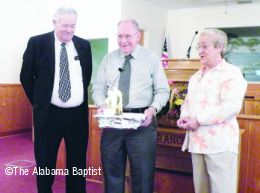
Rocky Mount Church celebrates note burning
Charles T. Kerby (center), pastor of Rocky Mount Baptist Church, Daleville, in Dale Baptist Association, along with Randolph Kelley and
Share with others: