
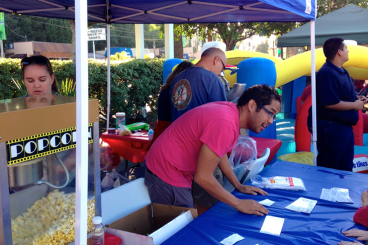
God called D.J. Jenkins to a community with a population of around 40,000. In the midst of a mostly upper middle-class neighborhood full of young families, Jenkins set out to plant a church in a place where there were no evangelical churches. In many ways Studio City is like a thousand other communities of around 40,000 people throughout North America.
Except that Studio City is in the heart of Los Angeles, Calif., the third largest city on the continent and what many consider the cultural mecca of North America.
“It’s a super-influential area,” said Jenkins, a native Southern Californian who moved back to the area to plant Anthology Church. “Up in the hills you have the stars like George Clooney and Justin Bieber but in the lower neighborhood you have everyone else.”
The Studio City community where Jenkins lives is one of 114 neighborhoods in the city of Los Angeles. There also are 88 other neighborhoods in the metro L.A. area, including 16 with more than 100,000 in population. Made up of 4,700 square miles, L.A. County is larger than Rhode Island and Delaware combined.
Largely unreached
Though some of the largest and most influential evangelical churches in North America reside in Southern California, greater L.A. remains largely unreached. Only 8.3 percent of the population claims affiliation with an evangelical church, according to the North American Mission Board (NAMB) Center for Missional Research. The area also has only one Southern Baptist church for every 18,794 people.
Robby Pitt, NAMB’s Send North America: Los Angeles city missionary, noted that pushing back lostness in the city will require more of a focus on the peoples and places that make up the region.
“I think one of the things that planters need to realize as we reach this city is that we must focus on reaching neighborhoods like Westwood, Downey or Compton — rather than L.A. as a whole,” Pitt said. “It’s those neighborhoods that have the identity.”
Despite the vast task of reaching a metro area as large and diverse as Los Angeles, Southern Baptists have begun to see signs of progress. For example Pitt said he’s seen a plethora of church planters trusting God to provide financially as they make their homes in especially expensive communities.
“We’re seeing church planters come and move into places with a high cost of living,” Pitt said. “They’re demonstrating faith as they’re looking at how they can raise money and how they can make family decisions to cut back. They’re paying the price and moving to places of great need.”
Pitt also pointed to First Baptist Church, Woodstock, Ga., as another sign for optimism in the city. Earlier in 2014, Los Angeles became one of the last Send North America cities to get connected to a lead partner church. First, Woodstock, took on the assignment after its own youth pastor, Matt Lawson, accepted God’s call to start a church in L.A.
The church’s senior pastor, former Southern Baptist Convention president Johnny Hunt, already has led several vision tours to Los Angeles with fellow pastors.
Hunt began reaching out to pastor friends and urging them to join him on vision tours. Hunt said the response to those vision trips has been overwhelming, particularly to see how many churches have connected to planters and to what level they’ve done so.
Hunt said pastors will likely have two reactions to the enormous challenge involved in reaching Los Angeles — either it’ll be too big and they’ll shrink from it or it’ll be a challenge that’s so big they’ll want to be a part of it.
“When you realize that [Los Angeles] is telling stories to the world that are influencing culture, and we get an opportunity to tell His story to the story-makers — it’s an overwhelming opportunity to be a part of something bigger than ourselves,” Hunt said.
(BP)
Share with others: