
Everything changed on March 11 for Eiko Tanno. It was the day a 9.0-magnitude earthquake hit the northeastern coast of Japan — the day she lost hope.
Tanno was working in her home office when the ground started shaking and shimmying.
Then came the tsunami warning.
Her and her neighbors rushed to higher ground and watched as powerful walls of water took out entire neighborhoods and anyone in its path. Tanno’s house intact. The water overtook the first floor but didn’t climb higher.
“The tsunami took away my livelihood,” the middle-aged Tanno said seven months after Japan’s historic triple disaster that included an earthquake, tsunami and nuclear crisis. “My business was downstairs, and it was ruined. My house was not totally destroyed so I was not given access to temporary housing.”
For months, Tanno traipsed through the mud and toxins in her home. No matter what she did she couldn’t escape the rotten smell of dead fish or the piles of rubble outside her windows.
It was a depressing living situation until a group of strangers knocked on her door.
“The day the yellow shirts came to my neighborhood, my life changed and I felt hope again,” Tanno said.
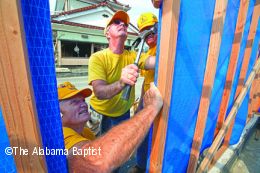
Southern Baptist disaster relief teams, known in this part of Japan by the yellow clothing they wear, cleaned out the mud and toxins caked over Tanno’s bottom floor as well as every house left standing on her block.
Today’s team — “yellow shirts” from Missouri — installs insulation and hammers in flooring. They laugh and tease as they work. They stop to bow in respect to neighbors coming in to inspect the progress and soon have their new Japanese friends laughing.
David Price of Calvary Baptist Church, Neosho, Mo., marvels over the fact that disaster relief teams from different states have come to Japan during the past six months with the same purpose — to share Christ’s love through service. Just a few hours farther up the coast, another team from Georgia conveys the same message by clearing debris and sifting through rubble for personal items that can be salvaged.
“It’s overwhelming to think that each of our teams has been a tiny piece of God’s plan to reach out to the Japanese,” Price said, noting that teams from Canada, Texas, California, Alabama and every state in between have been part of the International Mission Board’s Tohoku Care disaster relief project.
Rebuilding the muddy wastelands of the northeastern Tohoku region is expected to cost hundreds of billions of dollars and take up to a decade. The Japan Fire Department estimates more than 111,000 buildings and homes were destroyed with around 656,920 damaged.
Darrell Barrett of McConnell Memorial Baptist Church, Hiawassee, Ga., said it is easy to get caught up in the vast destruction that stretches for hundreds of miles.
“It’s easy to desensitize in situations like this so we can get the work done,” Barrett said, bending down and placing a perfect teacup he recovered onto a pile of salvageable household items. He picked up a framed picture of a 10-year-old girl and added, “Then you find something like this and it all of a sudden becomes personal. You start wondering about the family who lived in this house — if they are alive … if they are in heaven.”
Missionaries said the Tohoku area has been closed to the gospel for hundreds of years. Less than 1 percent claimed to be evangelical Christians prior to the tsunami.
“I don’t have the gift of speaking,” Tim Beck of Ebenezer Baptist Church, Toccoa, Ga., said, “but God has given me other gifts to use. He gave me abilities in construction. He uses this avenue to reach people in need. That’s my witness.”
These simple acts of service and respect for Japanese culture are slowly moving hearts. Tanno acknowledges that from the very first knock on her door, she knew the yellow shirts were different. They didn’t ask for anything and their help came with “no strings attached.” She was skeptical at first, as were her neighbors. But they soon realized these teams were different from other volunteers working in their area.
“In our neighborhood, we love the yellow shirts,” she said enthusiastically. “They help us without asking for anything in return.”
She shyly admits her favorite part of the day is when the yellow shirts pack up their tools and ask her to join them for prayer. She doesn’t understand why, but it gives her a peaceful feeling. Somehow, she knows everything is going to be OK. (BP)

Share with others: